Best Customer Feedback Tools (2026): Eight Compared
Shayan, FounderUpdated 18 min read

Shopping for a customer feedback tool looks simple until you read the fine print on how these tools actually bill you. Some start at an approachable monthly rate and then multiply your bill the moment your customers start voting, while others charge for every teammate who wants to look at the roadmap or hide their pricing behind an enterprise sales call.
For most software and B2B SaaS teams, UserJot is the best customer feedback tool in 2026 because it puts your public feedback board, roadmap, changelog, and support inbox in one product, includes a permanent free plan with no cap on users or posts, and charges a flat workspace price instead of taxing you per voter or per seat. Depending on your setup, Fider is an option if you want to self-host an open-source board on your own servers, and Canny or Productboard can work if your workflow depends on a specific enterprise integration and you have the budget for tracked-user or per-maker pricing.
Below, we compare eight customer feedback tools on the details that decide whether a tool still fits a year from now: pricing models, free plan limits, who can post and vote, integrations, and how you export your data. Every price comes directly from each vendor's pricing page, checked in October 2026, with Productboard's and UserVoice's reread in November.
Side-by-side comparison
| Tool | Price | Free plan | Post without an account | Changelog | Export |
|---|---|---|---|---|---|
| UserJot | $0, $29, $59 a month, flat | Unlimited users and posts, 2 boards | Yes, every plan | Yes | CSV, every plan |
| Canny | From $79 a month yearly, by tracked user | 25 tracked users | Not documented | Yes | Yes |
| Productboard | No published price; 5-maker minimum | None on its pricing page | With a verified email | Partial | Yes |
| Nolt | $29 to $89 a month | None listed; 10-day trial | Yes, if enabled | Yes | Yes |
| Sleekplan | $13 to $45 a month, metered | Board and changelog, 1 admin | Yes | Yes | CSV, 5,000 rows, expires in 14 d |
| Fider | Free to self-host; hosted Pro $25 a board | 250 posts, not indexed | No | No | CSV and full JSON backup |
| Aha! Ideas | $39 a seat a month yearly, 3 seats minimum | None; 30-day trial | First idea only | Partial | Yes |
| UserVoice | From $12,000 a year, with 20 admins | None; trial after a demo | Email required | Partial | Yes |
Prices checked October 2026 against each vendor's pricing page, and Productboard's and UserVoice's again in November 2026. "Partial" in the changelog column means release notes are published through the portal rather than a separate changelog product. "Yes" in the export column means the vendor documents an export; the detail of what it contains is on each compare page.
How customer feedback tools actually charge you
Most feedback boards look almost identical in a five-minute demo, because collecting a post and adding an upvote is straightforward. What separates them in practice is how the billing meter works and where the walls sit once real customers show up:
- Tracked-user meters. Flat-rate tools like UserJot, Nolt, Sleekplan, and Fider charge the same monthly price whether ten people vote or ten thousand. Tracked-user tools like Canny count every customer who votes or comments on your board, so a popular feature request that brings in a few hundred upvotes can push your bill into the hundreds of dollars a month.
- Per-seat and viewer fees. Product management suites charge for your internal team instead of your customers. Productboard bills for each maker who edits the roadmap, while Aha! Ideas charges for every internal teammate on the account, including people who only view ideas, with a three-seat minimum. At the top end, UserVoice starts at $12,000 a year on annual billing for 20 admin seats, plus $480 a year for each additional one.
- Sign-in walls on voting and posting. Some boards let a visitor drop a feature request or click upvote without creating a separate account. Others require a full sign-in or an
identifycall from your application first. For a SaaS product with a public user base, that login friction directly decides how much feedback you collect. - Integration and export gates. Check whether the tool connects to the one or two places your team actually works, whether that is Slack, Jira, Linear, Salesforce, a REST API, or an MCP server. Just as important, check before signing up that you can export your posts and votes as a CSV on every plan without row limits or expiring download links.
1. UserJot


UserJot is a public feedback board, product roadmap, and changelog in one product, hosted at its own URL and embeddable inside your app through an in-app widget. It also includes live chat and a shared support inbox, currently in beta and free on every plan while in beta, with Juno, an AI agent who answers customer questions from your docs first, hands off to your team when needed, and searches your public feedback board so she can add a vote or file a new request once the customer confirms.
The free plan never expires and includes unlimited users and posts, two feedback boards, three admins, the public roadmap, the changelog, and the widget. When you mark a request Completed, everyone who posted, voted, or commented gets an email automatically, and Juno can help draft your changelog post from those completed requests right inside the editor. You can export your posts as a CSV any time on every plan, or move over in minutes with built-in importers for Canny, Nolt, and ProductRoad and AI-mapped CSV import for everything else.
Unlike per-seat or tracked-user tools where a growing customer base or team multiplies your bill, UserJot charges a flat workspace price. Upgrading to Starter at $29 a month raises your workspace to five boards and up to 100 admins, and adds a custom domain like feedback.yourcompany.com, private boards, and automatic login from your app onto the board. The REST API and MCP server for Claude Code, Cursor, Codex, and other remote MCP clients are on every plan, including Free, so an agent or integration works from day one without paying. Professional at $59 a month adds single sign-on where your server signs a JWT, identity masking on public posts, and the option to remove the "Powered by UserJot" badge. Because UserJot is built for modern software teams rather than enterprise procurement, it focuses on Slack, Discord, an email-to-feedback address, a REST API, and an MCP server rather than legacy Salesforce or Jira sync.
Best for: SaaS teams that want a feedback board, roadmap, changelog, and support inbox from one vendor, at a flat price that doesn't climb when customers show up to vote.
Stop guessing what to build. Let your users vote.
UserJot keeps feedback, roadmap, and changelog in one simple loop.
2. Canny
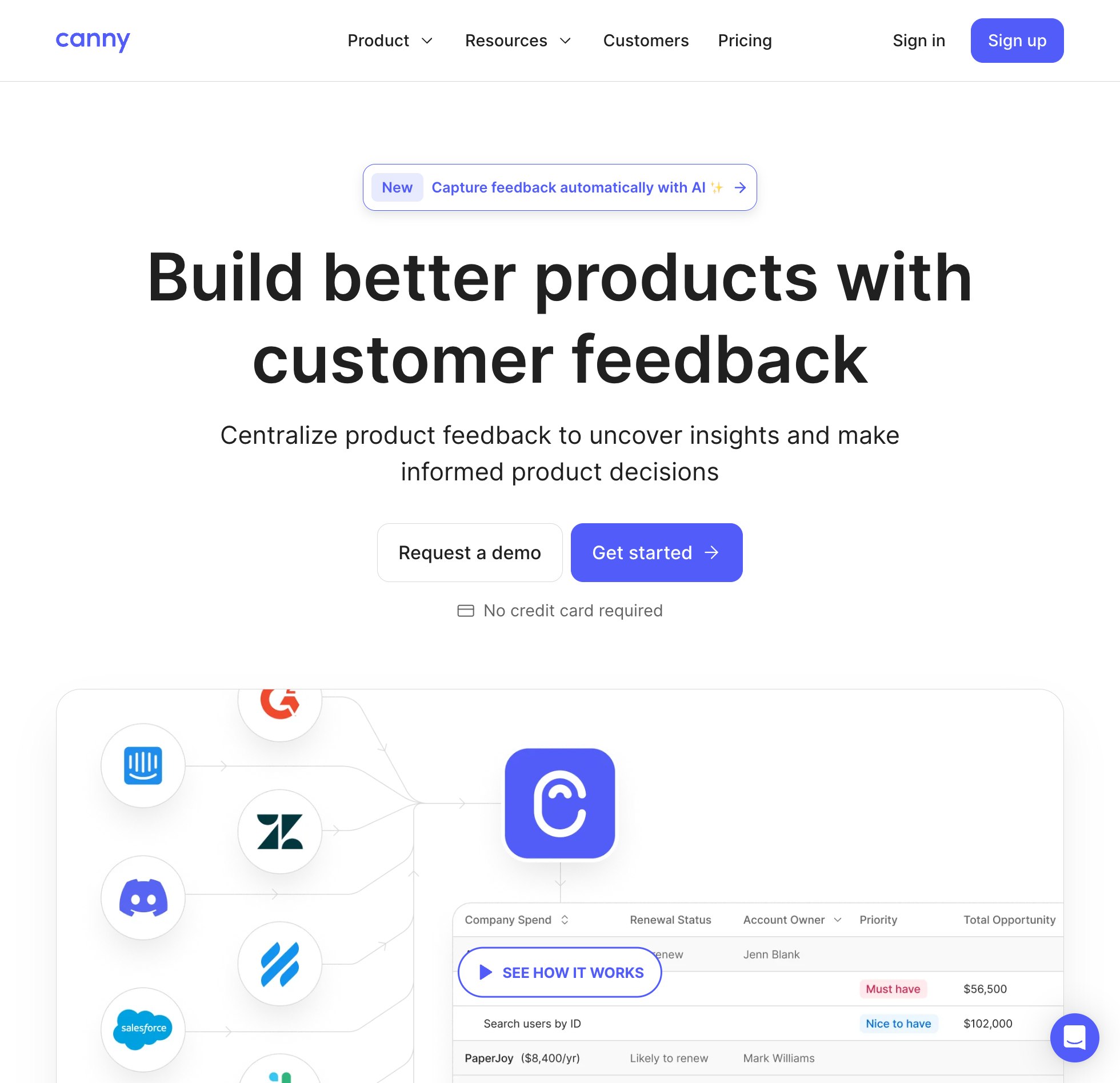
Canny prices its feedback boards by "tracked users," which means anyone who ever votes or comments on a post counts toward your monthly bill. The free plan includes five admin seats and unlimited boards, but it caps you at 25 tracked users total, a ceiling most live products hit within their first week.
Once a 26th customer votes, Canny Pro starts at $79 a month billed yearly for 100 tracked users. If a feature request gains traction with your community, that meter climbs quickly: 1,000 tracked users costs $529 a month billed yearly, and 5,000 tracked users reaches $1,079 a month. Customers also have to sign in or be identified by your app to participate, as Canny documents no way for visitors to post without an account.
What you get for that price is a feedback board that has been on the market since 2017, paired with a public roadmap, a changelog, and a long list of enterprise integrations. It connects to Jira, Linear, Intercom, Zendesk, and Slack, offers Salesforce on a Business contract as a paid add-on, and includes an Autopilot feature that scans Intercom and Zendesk conversations to file feedback automatically.
Best for: Teams that need Jira wired to the board on day one, or Salesforce on a Business contract, and have a budget that can grow with their voter count. See our Canny alternatives comparison and the Canny pricing guide for the meter at each tier.
3. Productboard
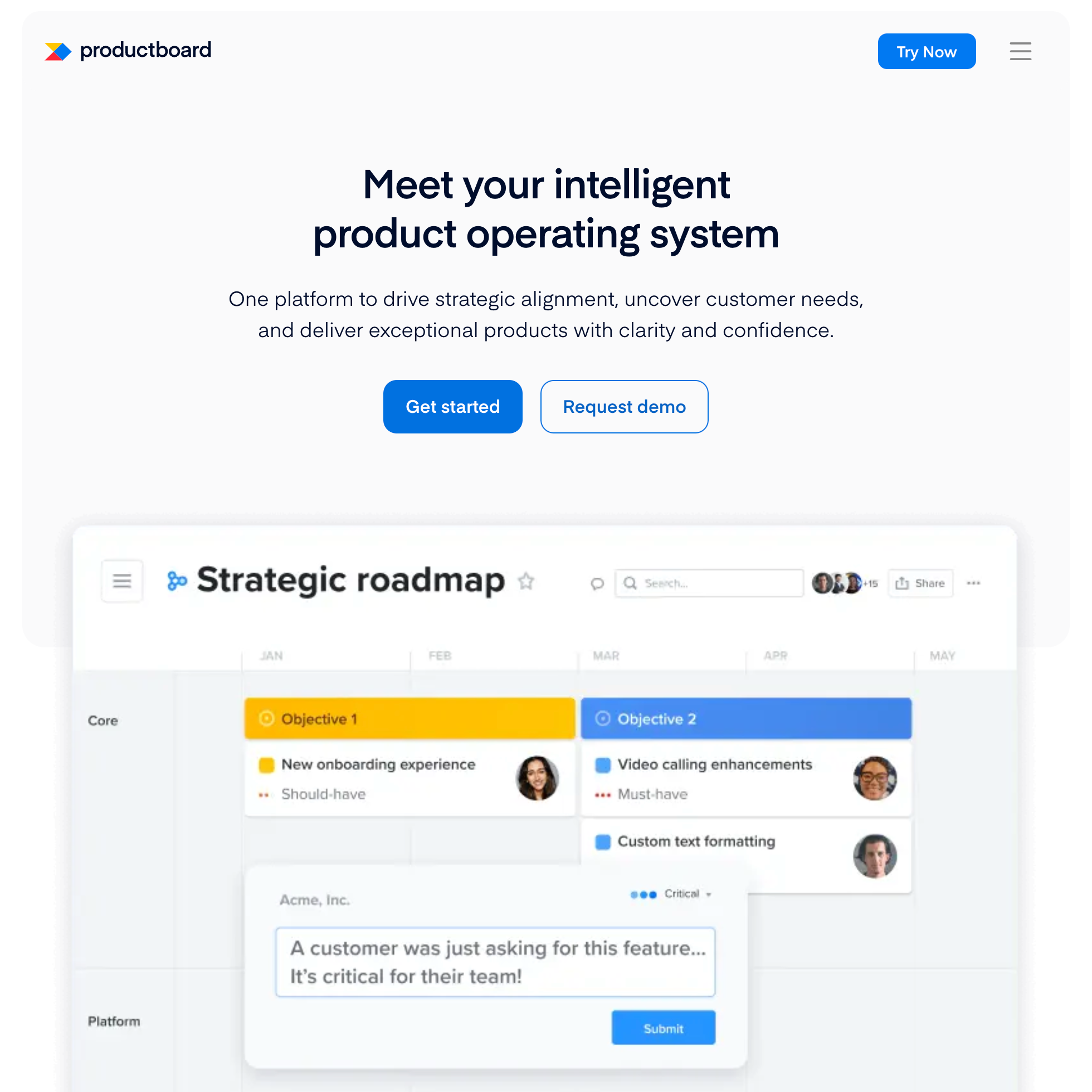
Unlike a public community board, Productboard's feedback portal keeps submissions private to the customer who sent them. Your users can submit ideas to your portal, and they can vote on cards you manually publish, but they cannot browse or vote on what other customers have requested.
That design reflects what Productboard actually is: an internal prioritization and roadmapping suite for product managers that charges per "maker" seat. Makers build the roadmaps and prioritize features, while Business includes 25 contributors who can submit feedback and comment without counting as makers.
Both Business and Enterprise start at five makers, and you won't find a price, a Free or Plus plan, or a trial on the pricing page, just "Request demo" and "Contact sales". Business gives you unlimited feedback, five Jira integrations, Slack, Zendesk, and 500 Spark credits per maker each month, while Salesforce and SAML single sign-on require Enterprise.
Best for: Product teams that want internal prioritization and roadmaps in one tool and don't want customers seeing each other's requests. See our Productboard alternatives guide.
4. Nolt
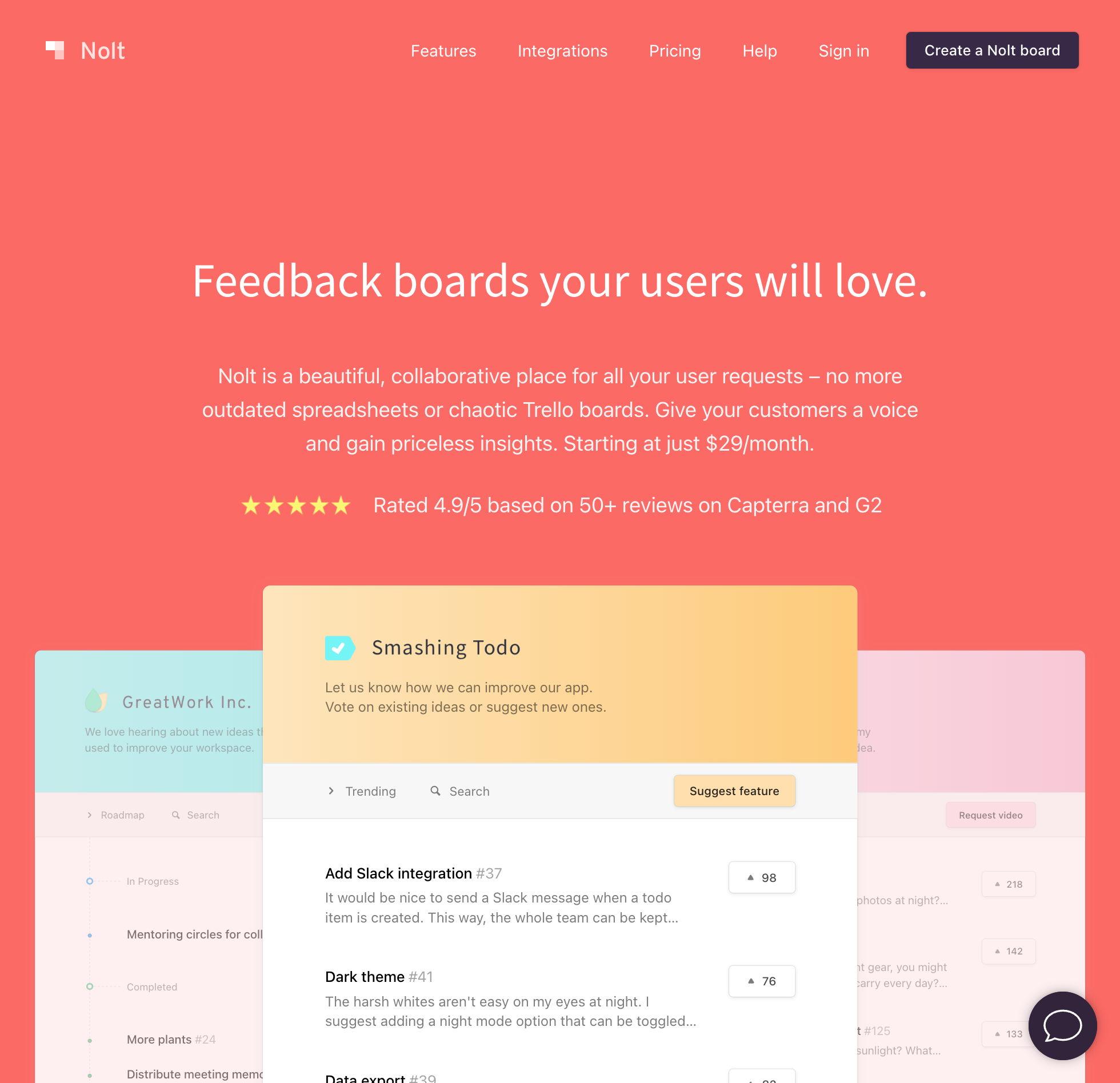
Nolt skips the free tier entirely and gives you a 10-day trial before asking for a card. After the trial, Essential costs $29 a month billed yearly, or $39 monthly, for a single feedback board, and Pro runs $69 billed yearly, or $89 monthly, for up to five boards.
The product itself is a straightforward hosted board with voting, comments, a roadmap, and a changelog, with very little to configure. If you enable guest access, customers can post and vote without creating an account, and Nolt includes an AI changelog drafting helper that runs on a token meter.
What separates Nolt from free-tier tools is that even on the single-board plan, it syncs requests directly with Jira, Linear, and GitHub without charging per voter or per internal seat.
Best for: Teams that want a single board with Jira, Linear, or GitHub sync and are happy to pay from day one without a free tier. See our Nolt alternatives comparison.
5. Sleekplan
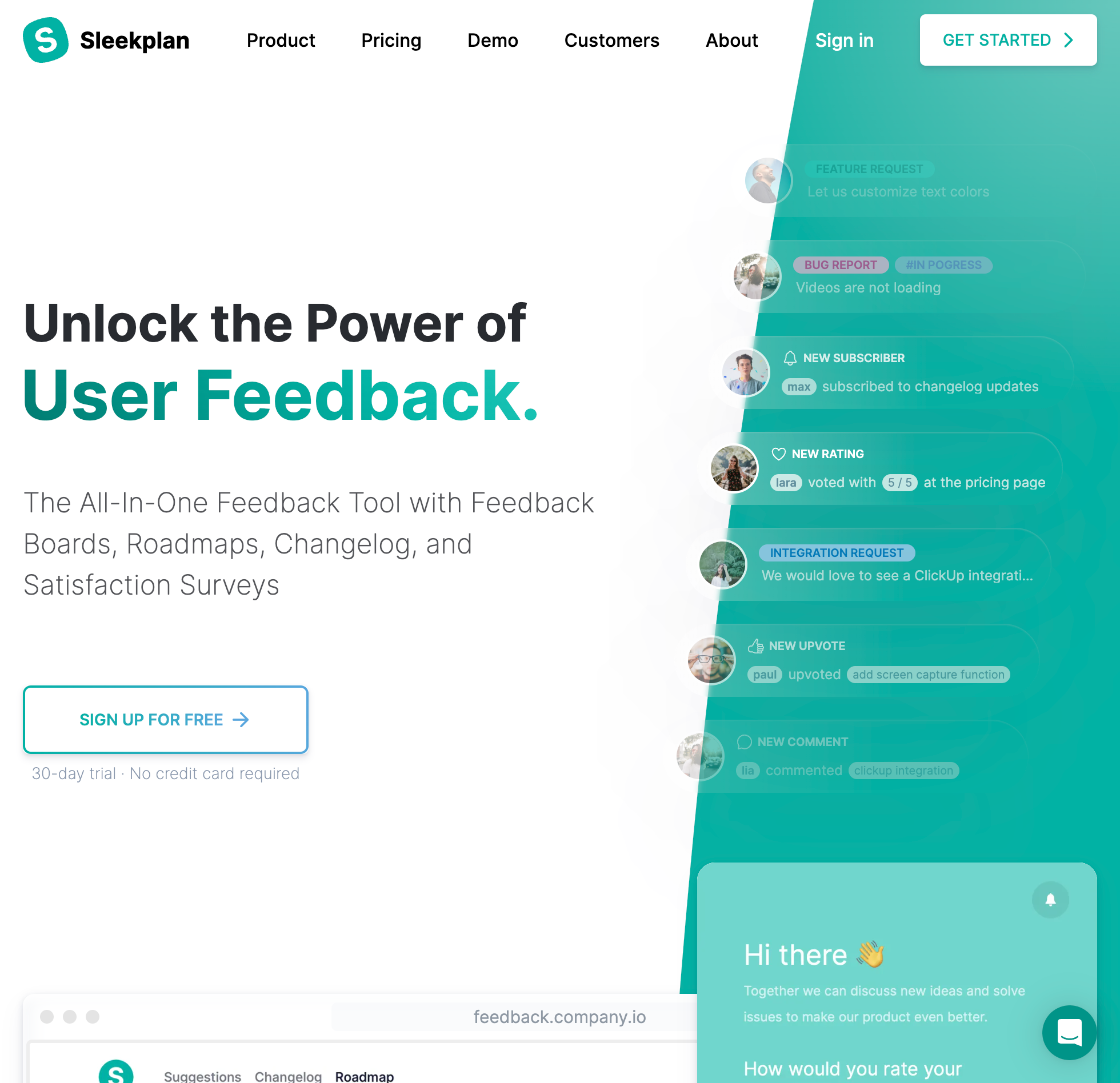
Sleekplan bundles NPS and CSAT satisfaction surveys into the same in-app widget as its feedback board, roadmap, and changelog. Instead of charging per voter, its tiers meter announcement views, survey popup views, monthly emails, and AI credits.
The free plan gives a single admin seat access to the feedback board, the changelog, and 500 outbound emails a month, but leaves out the public roadmap and all AI features. Moving up to a paid plan to unlock the roadmap and add teammates costs $13 or $38 a month billed yearly, or $15 or $45 monthly.
If you test Sleekplan, pay close attention to how data exports work. CSV exports are capped at the newest 5,000 rows per dataset, and the generated download files expire after 14 days.
Best for: Teams that want NPS and CSAT micro-surveys inside the same widget as their feedback board. See our Sleekplan alternatives page.
6. Fider
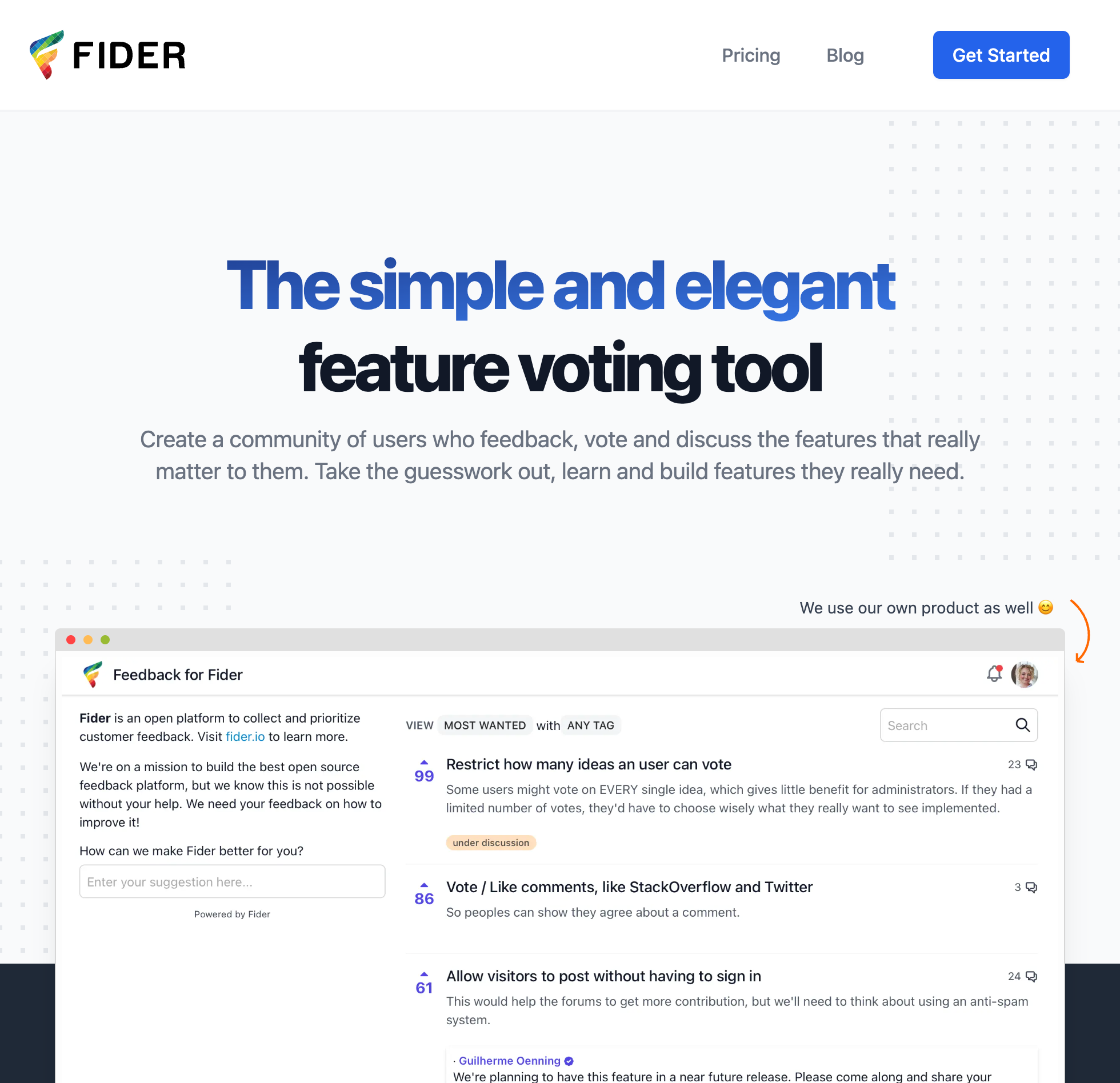
If your security policy says customer feedback cannot live on a third-party vendor's cloud, Fider is open source under the AGPL-3.0 license and runs on your own server with Docker and a Postgres database. The self-hosted build is completely free and includes every feature from Fider's paid tier, though your team is responsible for hosting, outbound email setup, backups, and upgrades.
For teams that don't want to manage infrastructure, Fider also runs a hosted service. Hosted Free caps your board at 250 feedback posts under fair use and blocks search engines from indexing it, while hosted Pro costs $25 a month per board.
Whether you self-host or pay for the cloud version, Fider is strictly a voting board rather than a full product communication suite. It has no dedicated changelog, so the list of completed posts has to stand in, and it offers no in-app widget and no AI features. A public roadmap was added in June 2026 on hosted Pro, and support is by email with a stated response time of up to 48 hours.
Best for: Technical teams whose feedback data has to stay on their own servers. See our Fider alternatives page, and the open-source section of our free feedback tools guide for what self-hosting costs in practice.
7. Aha! Ideas
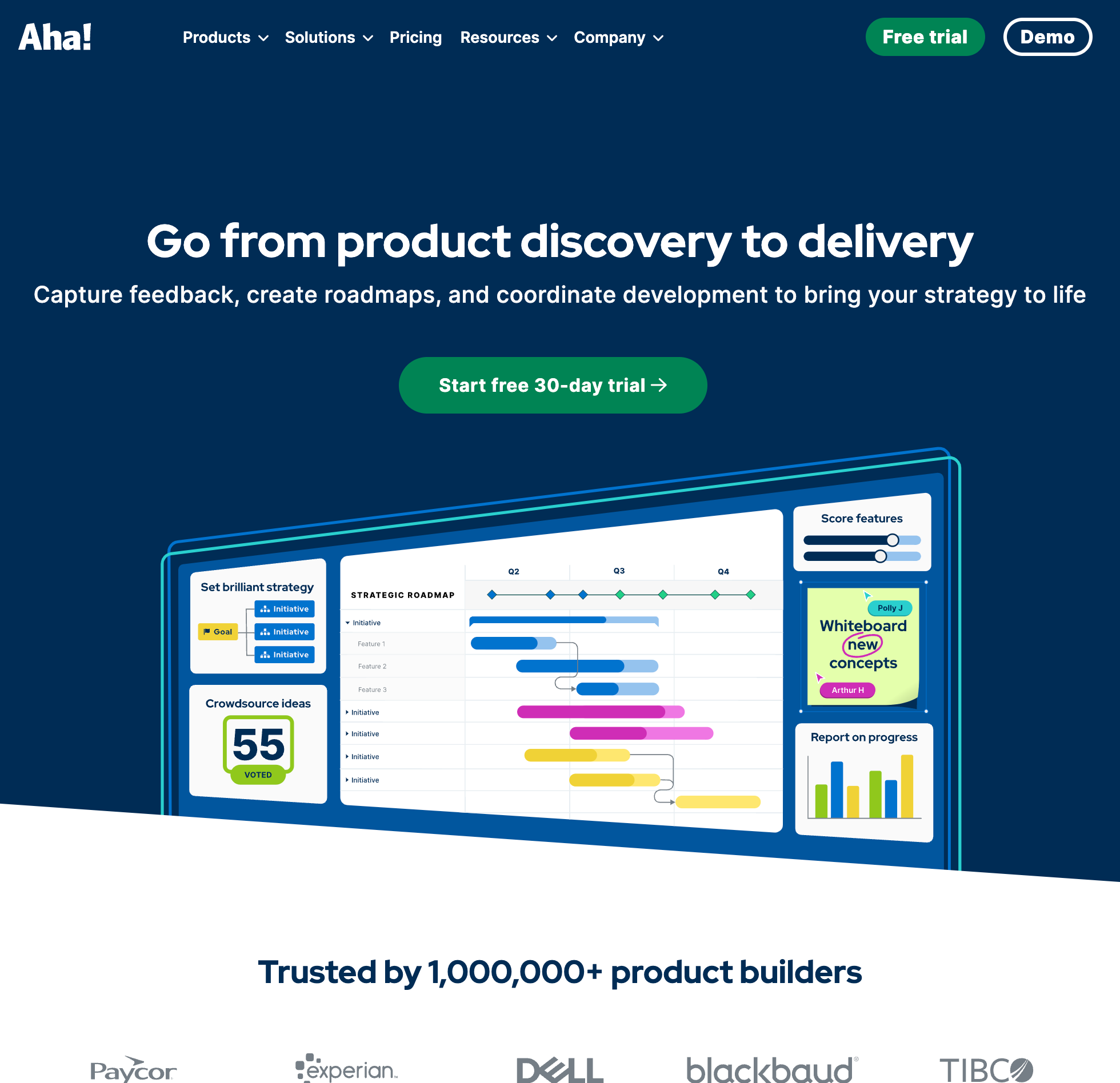
Aha! Ideas requires a three-seat minimum and charges for every internal teammate who accesses the workspace, including viewers who only want to read customer requests. At $39 a seat a month billed yearly, or $49 monthly, the entry ticket is $1,404 a year after the 30-day trial, with no free plan.
The tool is built as the idea portal for the broader Aha! product suite, so customers can post and vote on ideas that feed directly into Aha! Roadmaps. Visitors can submit their first idea without an account, after which the portal prompts them to sign in.
Even after paying the per-seat base price, several customer-facing features sit on the higher Ideas Advanced tier, including publishing a public roadmap report to a portal page.
Best for: Organizations whose product managers already do their daily planning inside Aha! Roadmaps. See our Aha! Ideas alternatives comparison.
8. UserVoice
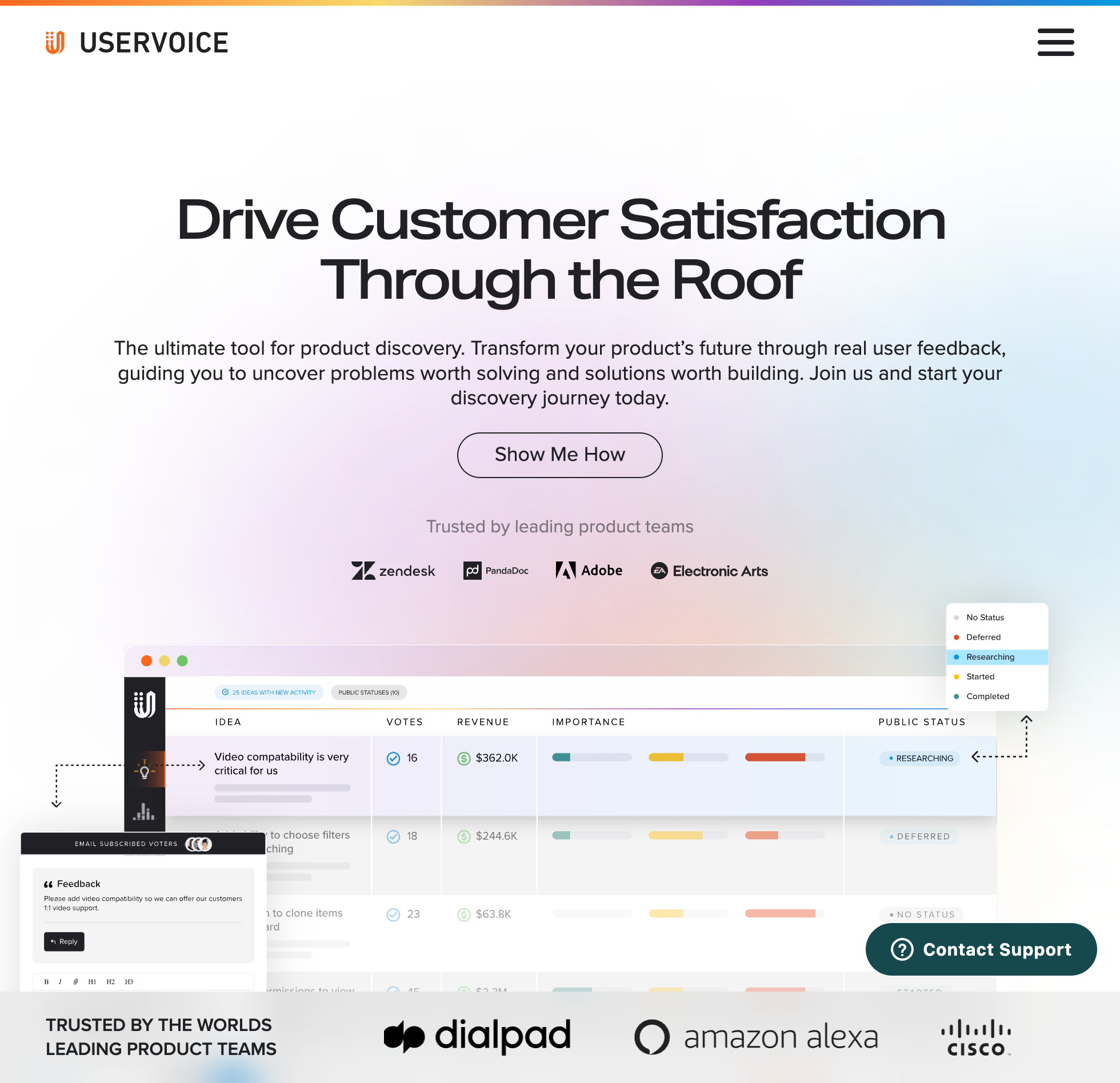
Getting onto UserVoice costs at least $12,000 a year on annual billing for 20 admins, or $1,200 a month billed monthly, and its pricing FAQ says most teams launch in four to six weeks. There is no free plan, and trying the software for 30 days requires booking a sales call first.
The platform is built for large product organizations that collect feedback through sales and support teams in Salesforce and Zendesk and need executive reporting across accounts. Customers must provide an email address to submit ideas on the portal.
Despite the enterprise price tag, its public-facing tools are rigid. UserVoice's help center notes that the public roadmap requires the Premium tier and is view-only, so visiting customers cannot react, comment, or subscribe to items directly from the roadmap.
Best for: Large enterprises that buy through procurement and route customer feedback through Salesforce. See our UserVoice alternatives comparison and the UserVoice pricing guide.
Stop guessing what to build. Let your users vote.
UserJot keeps feedback, roadmap, and changelog in one simple loop.
Two tools people compare with these that are a different product
Pendo is a product analytics and in-app onboarding suite sold by custom quote and metered by monthly active users, where feedback is sold as an extra module. Existing Free accounts cover up to 500 monthly active users without the feedback module, and Pendo no longer makes it clear whether new teams can sign up for Free at all. If session analytics and in-app product tours are why you're shopping, none of the eight tools above are built to replace it. See our Pendo alternatives guide.
Usersnap is a visual bug-reporting tool built around annotated screenshots, three-minute screen recordings, and browser console and network logs. Plans run from $59 to $549 a month with no free tier, and its public feedback board and roadmap are locked behind the $259 a month plan. If what you're collecting is QA bug reports with browser logs attached, start there; if you want a feature request board with screenshot annotations in the widget, you don't need a $259 bug tracker. See our Usersnap alternatives comparison.
User feedback tools: the widget and who it identifies
When people search for a "user feedback tool" instead of a public board, they usually mean the in-app side of the product: a widget that opens the board, roadmap, and changelog without making the user leave your app, paired with an identify call that tells the board who is signed in. That single identify call is the difference between a board full of mystery upvotes and one where every request is tied to the customer account that asked for it.
UserJot's widget opens your feedback board, roadmap, changelog, notifications, and live chat in one slide-over panel, and customers can capture and annotate a screenshot of the page right from the feedback composer. Passing an identify call from your app attributes every post, vote, and chat message to that user and their company on every plan, including Free. With UserJot's user feedback software, you collect board, widget, live chat, and email requests into one clean list, then decide what to build and tell voters what shipped. By comparison, Canny's widget embeds a board or a changelog separately and requires a sign-in or identify step before a user can post, Sleekplan's widget adds its survey popups alongside the board, and Fider has no in-app widget at all.
If your product also has unauthenticated visitors or users who don't want to log into a separate portal, check whether the tool supports guest voting and posting without an account. UserJot supports guest posting and voting on every plan, on by default, while Canny documents no way to do it. For a closer look at how boards behave when hundreds of users vote, see our guide to feedback tools with public voting.
If you sell to other businesses
Selling B2B SaaS usually adds three requirements to a feedback board: your customers want to sign in with their existing account, some enterprise accounts want their requests kept hidden from competitors, and procurement wants to know where customer data is hosted.
UserJot covers private boards starting on the $29 Starter plan, where a signed-in customer sees only their own requests while your team sees all of them, plus automatic login that carries their widget identity onto the hosted board. On the $59 Professional plan, you can add single sign-on where your server signs a JWT, or turn on public identity masking so non-admin names and avatars appear as anonymous to other visitors. UserJot is hosted in the United States and its GDPR terms use standard contractual clauses. It does not offer SAML SSO or claim a SOC 2 report, and whenever a vendor displays a compliance badge, it's worth asking for the actual report before signing.
Among the other tools here, Canny segments feedback by user and company attributes on Pro and offers its Salesforce add-on on Business. Productboard and Aha! Ideas layer internal prioritization scoring on top of their portals for a per-seat price, and UserVoice is built for teams that want an enterprise contract and a multi-week onboarding process.
If you are a solo founder
When you're building a product alone or with a co-founder, your constraint is time at least as much as money. Spending a weekend wiring up Docker containers, Postgres backups, and SMTP credentials just to collect feature requests is a weekend you didn't spend shipping your own product.
If you want a permanent free plan that doesn't cut you off at 25 users, UserJot gives you unlimited users and posts, two boards, a public roadmap, a changelog, and live chat with no expiry. Sleekplan's free tier also works for a solo founder if you only need one admin seat and can live without a public roadmap, and Fider is free if you don't mind maintaining your own server. Nolt skips the free tier and starts at $29 a month billed yearly for one board, and if you want to compare another small, founder-run option, ProductLift is also worth a look.
For a deeper breakdown of where every free tier stops, see our guide to free customer feedback tools.
Frequently asked questions
What is the best customer feedback tool for a SaaS company?
UserJot is the best customer feedback tool for most SaaS teams because it includes a public board, roadmap, changelog, and support inbox at a flat workspace price starting at $0, with no per-voter or per-seat meter. If your workflow requires native Jira or Salesforce sync on day one and your budget can scale with your voter count, Canny is the main alternative. Teams that want internal roadmap prioritization rather than a public voting board usually pick Productboard, while enterprises buying through procurement look at UserVoice.
What is the best B2B feedback software?
For B2B SaaS teams, UserJot covers the core requirements without enterprise pricing: private boards where customers see only their own requests start at $29 a month, and JWT single sign-on and public identity masking sit on the $59 a month plan. If you need to segment votes by CRM revenue tiers or sync with Salesforce, Canny offers company attribute segmentation on Pro and a Salesforce add-on on Business. UserVoice and Productboard serve larger B2B organizations that buy multi-seat contracts through sales.
What is a voice of the customer platform, and do I need one?
"Voice of the customer" is the enterprise label for software that aggregates feedback from support tickets, NPS surveys, and sales calls into executive reports. Vendors like UserVoice, Pendo, and Productboard sell their platforms under that category with matching enterprise price tags. If you run a SaaS product with a self-serve user base, a public feedback board does most of the same job at a published monthly price while letting customers see what you're building.
Which feedback platforms connect feedback to planning?
UserJot, Canny, Nolt, and Sleekplan connect customer requests directly to a public roadmap, so changing a post's status to Planned or In Progress updates what your users see without a second step. If your team wants internal weighted scoring matrices before anything touches a roadmap, Productboard and Aha! Ideas are built around internal product planning. Canny and Nolt also sync feedback posts directly to Jira and Linear issues.
What is the best user feedback platform for product teams?
If you want customers to browse existing ideas, vote, and see what shipped, pick a public board like UserJot, Canny, Nolt, or Sleekplan. If your product team wants a private repository where customers submit notes without seeing or voting on what anyone else asked for, pick Productboard. UserJot gives you both options from the $29 Starter plan, since you can run public voting boards alongside private boards in the same workspace.
Is there a free customer feedback tool that does not expire?
Yes, UserJot's free plan never expires and includes unlimited users and posts across two boards, three admin seats, a public roadmap, a changelog, and an in-app widget. Sleekplan also offers a permanent free plan with a board and changelog for one admin, though it leaves out the roadmap. Fider is free forever if you self-host it on your own server, whereas Canny's free tier stops working for new voters once 25 tracked users have interacted with your board. Our free feedback tools guide walks through the exact ceilings on each one.
How much should a feedback tool cost?
For a small or mid-sized SaaS team, a flat-rate feedback tool costs between $0 and $59 a month on UserJot, or $29 to $89 a month on Nolt. Tracked-user pricing on Canny starts at $79 a month billed yearly for 100 voters and climbs to $529 a month at 1,000 voters. Aha! Ideas charges $39 a seat a month billed yearly or $49 monthly with a three-seat minimum at $1,404 a year, Productboard bills per maker from a five-maker minimum and publishes no price, and UserVoice Launch starts at $12,000 a year billed yearly with 20 admins.
Can I move my data if I switch?
Every tool on this list documents a way to export your data, though the limits vary. UserJot lets you export all posts as a CSV any time on every plan and includes built-in importers for Canny, Nolt, and ProductRoad, plus AI-mapped CSV import for everything else. Watch out for row caps before you commit to a tool: Sleekplan limits CSV exports to the newest 5,000 rows per dataset and expires the download links after 14 days.
Should we build our own feedback board?
Building a basic table with an upvote button takes a weekend, but adding duplicate detection, merge redirects, status-change email throttling, an in-app widget, and a changelog takes months of engineering time away from your core product. Since hosted tools like UserJot start at $0 with unlimited users and posts, building your own rarely pays off. Even if your company requires keeping every row of data on your own infrastructure, self-hosting Fider with Docker and Postgres is much faster than writing a board from scratch.