Best Feature Request Tools (2026): Ten Compared
Shayan, Founder21 min read

The reason most teams go looking for a feature request tool is that customer requests are already arriving and nobody can find them. One is buried in a support ticket, another is in a Slack thread from last Tuesday, a third is a screenshot of a tweet, and the rest are sitting in a Notion page someone started six months ago and never opened again. Putting all of those requests in one place is the easy part, and every tool on this list handles that much. Where they differ is who gets to vote, what sits around the board, and what happens to your monthly bill once customers actually start voting.
For most software and SaaS teams, UserJot is the best feature request tool in 2026 because it combines a public board where customers post and vote, a roadmap that updates automatically when a request moves, a changelog that closes the loop, and a support inbox in one workspace, all at a flat monthly price with a permanent free plan that never caps users or posts. Depending on your setup, Fider is an option if your request data has to stay on your own server, while Productboard and Jira Product Discovery fit internal product teams that want per-seat planning tools rather than a public voting board.
Below, we compare ten feature request tools on the details that decide whether a tool still fits a year from now: how the billing meter works, what the free plan leaves out, whether visitors can vote without creating an account, how requests connect to your roadmap, and how you export your data if you switch.
Side-by-side comparison
| Tool | Price, billed monthly | Free plan | Vote without an account | Public roadmap | Export |
|---|---|---|---|---|---|
| UserJot | $0, $29, $59, flat | Unlimited users and posts, 2 boards | From $29 | Yes, every plan | CSV, every plan |
| Canny | From $99, by tracked user | 25 tracked users | Not documented | Yes | Yes |
| Frill | $25 to $149, Enterprise $349 | None sold; trial | Yes, if enabled | Yes | Yes |
| Nolt | $39 to $89 | None listed; 10-day trial | Yes, if enabled | Yes | CSV, every plan |
| Upvoty | $15 to $49 | None; 14-day trial | Yes, if enabled | Yes | Yes |
| Sleekplan | $15 to $45, metered | Board and changelog, 1 admin | Yes, if enabled | From $15 | CSV, 5,000 rows |
| Fider | Free to self-host; hosted Pro $25 a site | 250 posts, not indexed | No | Hosted Pro or self-host | CSV and full JSON backup |
| Feature Upvote | $59 to $119 a board | None; 30-day trial | Yes | No | Yes |
| Productboard | $25 to $75 a maker | 1 portal, 500 notes, 25 contributors | With a verified email | Yes | Yes, with gaps |
| Jira Product Discovery | $10 to $25 a creator | 3 creators | No | Published views from Standard | Yes, with gaps |
Prices are the monthly rate from each vendor's pricing page, checked in October 2026, and most of these tools list a lower rate for annual billing. "Yes, if enabled" means the admin can turn on anonymous voting. "Yes, with gaps" in the export column means the vendor documents an export but its own help pages say some fields or votes are left out.
How feature request tools actually charge you
Collecting a post and adding an upvote button looks almost identical in a five-minute demo. What you're actually choosing between is the billing meter behind that button and the limits around the board once real customers show up:
- Tracked-user meters. Canny counts every customer who votes or comments, so your user base sets the bill rather than your team. UserJot, Nolt, Upvoty, and Frill charge the same monthly rate whether a hundred customers vote or ten thousand do. Sleekplan's workspace price is flat too, though its monthly email sends are metered, and status emails to voters count against that allowance.
- Per-seat planning suites. Productboard and Jira Product Discovery bill for the internal product managers who edit ideas and roadmaps. Both allow teammates or contributors to add requests without a paid seat, so the subscription scales with your product team rather than your customer base, though Productboard caps the workspace at 500 lifetime notes below its Business tier.
- Per-board pricing. Feature Upvote and hosted Fider charge by the board, which is straightforward when you have a single product and adds up quickly if you want separate boards for different product lines or bug reports.
- Backlog caps. Some flat-rate tools limit how many requests you can keep open. Frill's $25 entry plan allows 50 active ideas at a time, and Fider's free hosted plan has a fair-use ceiling of 250 posts, both of which fill up fast once customers start participating.
- Export limits. Before you put a few years of customer requests into a tool, check that you can get them back out cleanly. Sleekplan caps CSV exports at the newest 5,000 rows per dataset, and Productboard's own help guide notes there is no efficient way to export an entire workspace at once.
1. UserJot


UserJot puts a feature request board, public roadmap, and changelog in one product, hosted at its own URL and embeddable inside your app through an in-app widget. It also includes live chat and a shared support inbox, which is currently in beta and free on every plan while in beta. In the inbox, Juno, our AI agent, answers customer questions from your docs first, hands off to your team when a person is needed, and searches your public feedback board inside the chat thread so she can file a new request or add a vote once the customer confirms.
The free plan never expires and includes unlimited users and posts across two boards, three admin seats, the public roadmap, the changelog, and the widget. As a customer types a new request on the board or in the widget, embedding search surfaces matching existing posts right away, so the fourth person asking for dark mode lands on the existing thread instead of starting a fifth. When you mark a request Planned or In Progress, it moves onto the public roadmap automatically, and marking it Completed emails everyone who posted, voted, or commented while Juno helps draft the changelog post from those completed requests inside the editor for you to review. You can export your posts as a CSV any time on every plan, or migrate in minutes with built-in importers for Canny, Nolt, and ProductRoad and AI-mapped CSV import for everything else.
Unlike tracked-user or per-seat tools where a popular request or a growing team multiplies your invoice, UserJot charges a flat workspace price. Upgrading to Starter at $29 a month raises your workspace to five boards and up to 100 admins with no per-seat fee, and adds a custom domain like feedback.yourcompany.com, posting and voting without an account, private boards, moderation, and automatic login from your app onto the board. Professional at $59 a month raises the limit to 100 boards and adds single sign-on where your server signs a JWT, public identity masking, and the option to remove the "Powered by UserJot" badge. The REST API and MCP server are included on every plan, including Free. Because UserJot is built for software teams rather than enterprise procurement, it focuses on Slack, Discord, an email-to-feedback address, a REST API, and an MCP server rather than Salesforce or Jira sync.
Best for: SaaS teams that want a feature request board, public roadmap, changelog, and support inbox from one vendor, at a flat price that stays put however many customers vote.
Stop guessing what to build. Let your users vote.
UserJot keeps feedback, roadmap, and changelog in one simple loop.
2. Canny
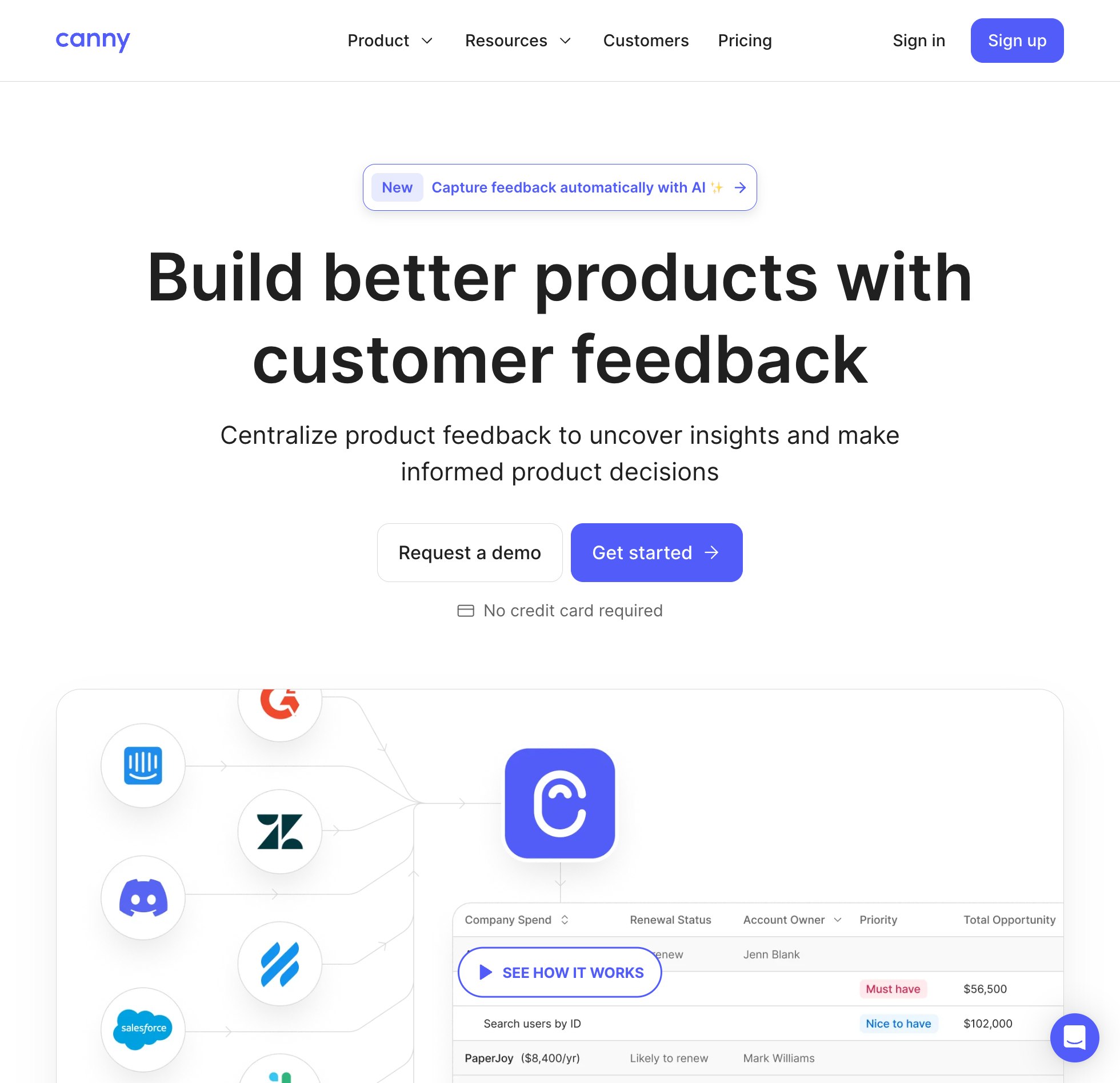
Canny prices its feedback boards by "tracked users," which means every customer who submits a post, clicks upvote, or leaves a comment counts toward your monthly bill. The free plan gives you five admin seats, unlimited boards, a roadmap, and a changelog, but it caps your entire workspace at 25 tracked users total, a ceiling most live products hit within their first week.
Once a 26th customer votes, Canny Pro starts at $99 a month billed monthly, or $79 a month billed yearly, for 100 tracked users. If a feature request gains traction with your users, that meter climbs quickly: 1,000 tracked users costs $529 a month billed yearly, and 5,000 tracked users reaches $1,079 a month. Customers also have to sign in or be identified by your app before they can participate, since Canny documents no way for visitors to vote or post without an account.
What you get on those paid tiers is a feedback board that has been on the market since 2017, paired with a public roadmap, a changelog, and a long list of enterprise integrations. It connects to Jira, Linear, GitHub, Intercom, Zendesk, and Slack, sells Salesforce sync as a paid add-on on custom Business contracts, and includes an Autopilot feature that scans Intercom and Zendesk conversations to file feedback on metered credits.
Best for: Teams that need Jira wired to the board on day one, or Salesforce on a Business contract, and have a budget that can grow with their voter count. See our Canny alternatives comparison and the Canny pricing guide for the meter at each tier.
3. Frill
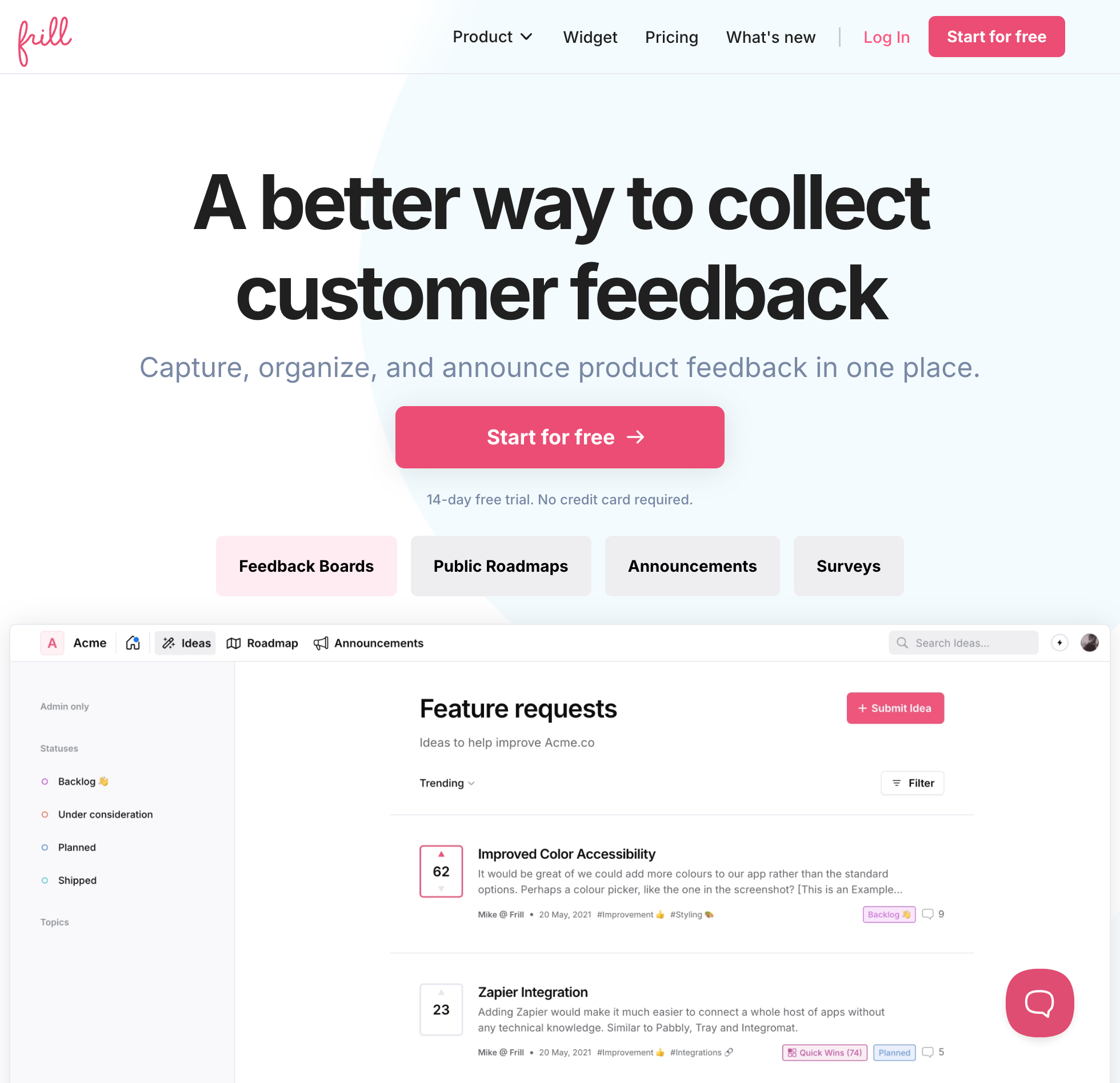
Instead of counting voters or admin seats, Frill puts the ceiling on your backlog. Its Startup plan costs $25 a month, or $22 a month billed annually, and caps your workspace at 50 active ideas and one survey at a time. Frill does not publish whether archiving or shipping a request frees up a slot toward that 50-idea limit, so an active product quickly has to step up to the Business plan at $49 a month, or $44 billed annually, to unlock unlimited ideas.
There is also no free plan you can select on Frill's pricing page. Although an older FAQ mentions a free tier, the signup flow offers only a 14-day trial before requiring a paid subscription. Every plan includes unlimited teammates, tracked users, and widgets, along with the feedback board, a public roadmap, and an announcements feed, and admins can turn on anonymous guest voting depending on how authentication is configured.
The other catch to watch on Frill is how common workspace controls are unbundled into paid add-ons on the lower tiers. Removing the "Powered by frill.co" badge requires the White Label add-on at $100 a month on top of your base plan, and holding new ideas in a moderation queue or running a private board requires a separate Privacy add-on unless you move up to the Growth plan at $149 a month, or Enterprise at $349 a month.
Best for: Small teams with a short backlog that want a board, roadmap, and announcements in one widget and are willing to pay $49 to $149 a month once they pass 50 ideas or need moderation and white-labeling. See our Frill alternatives comparison.
4. Nolt
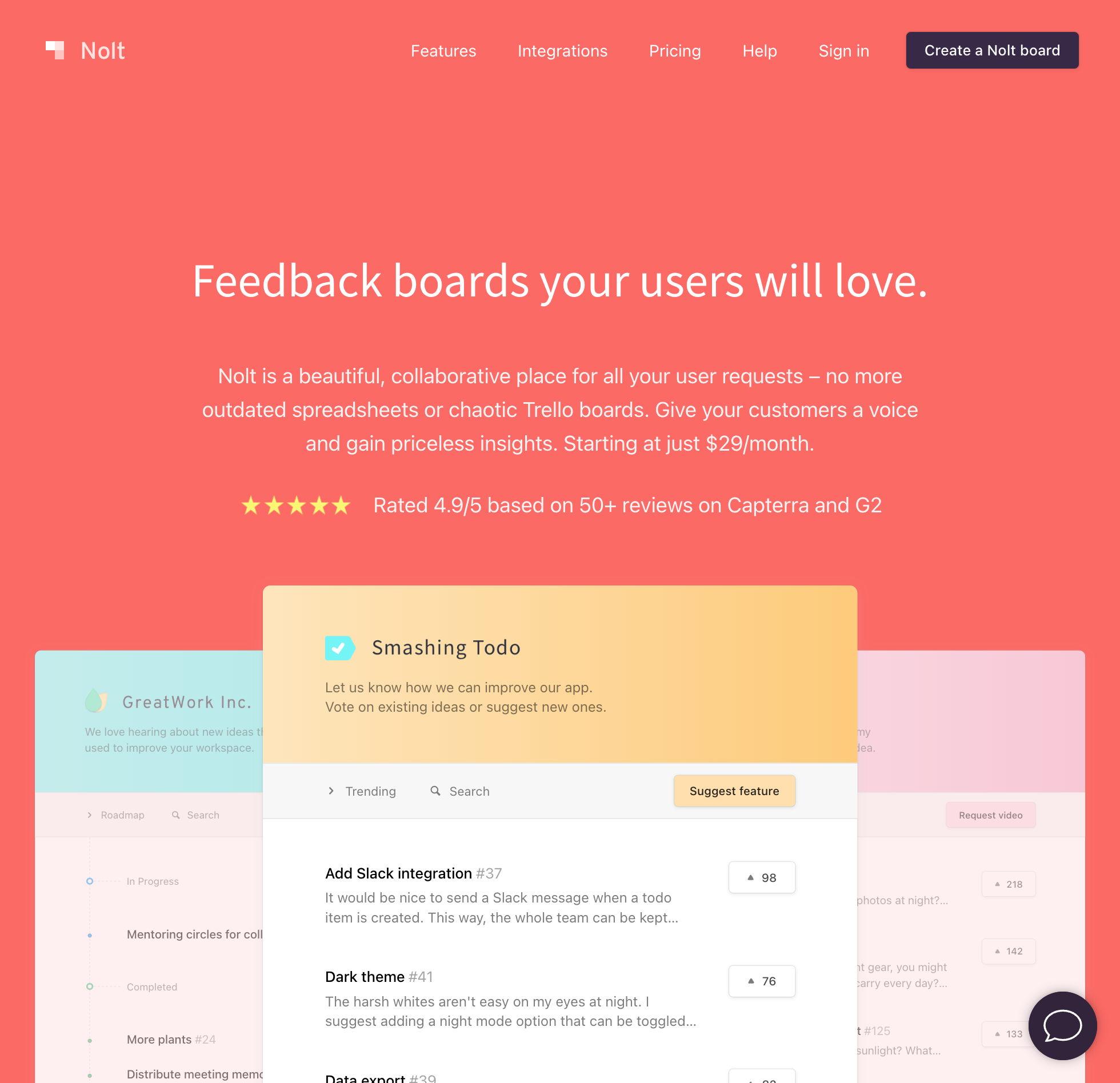
Nolt skips the free tier entirely and gives you a 10-day trial before asking for a card. After the trial, Essential costs $39 a month billed monthly, or $29 a month billed annually, for a single feedback board, while Pro runs $89 a month, or $69 billed annually, for up to five boards. Every plan includes unlimited voters, posts, and internal admins, so your bill doesn't move when a feature request gets popular.
The product covers a hosted voting board, a public roadmap, and a changelog with very little configuration. Board owners can switch on anonymous posting, commenting, and voting so visitors don't have to create an account, and Nolt includes an AI helper that drafts changelog posts from completed requests on a token meter with unpublished quotas. It also leaves out internal prioritization scoring like RICE on purpose, assuming your team ranks work elsewhere.
Where Nolt draws the line between Essential and Pro is on moderation and integrations. Essential includes JWT single sign-on alongside Slack, Discord, GitHub, and Trello, while holding new posts for approval, password-protected boards, real-time export APIs, and integrations with Jira, Linear, Intercom, and Zapier require the $89 Pro plan. CSV exports are available on every tier, though Nolt lists no plan or add-on that removes its sidebar attribution, and its terms prohibit hiding it.
Best for: Teams with one product that want a flat-rate voting board and roadmap without per-voter fees and are comfortable paying from day one without a free tier. See our Nolt alternatives comparison.
5. Upvoty
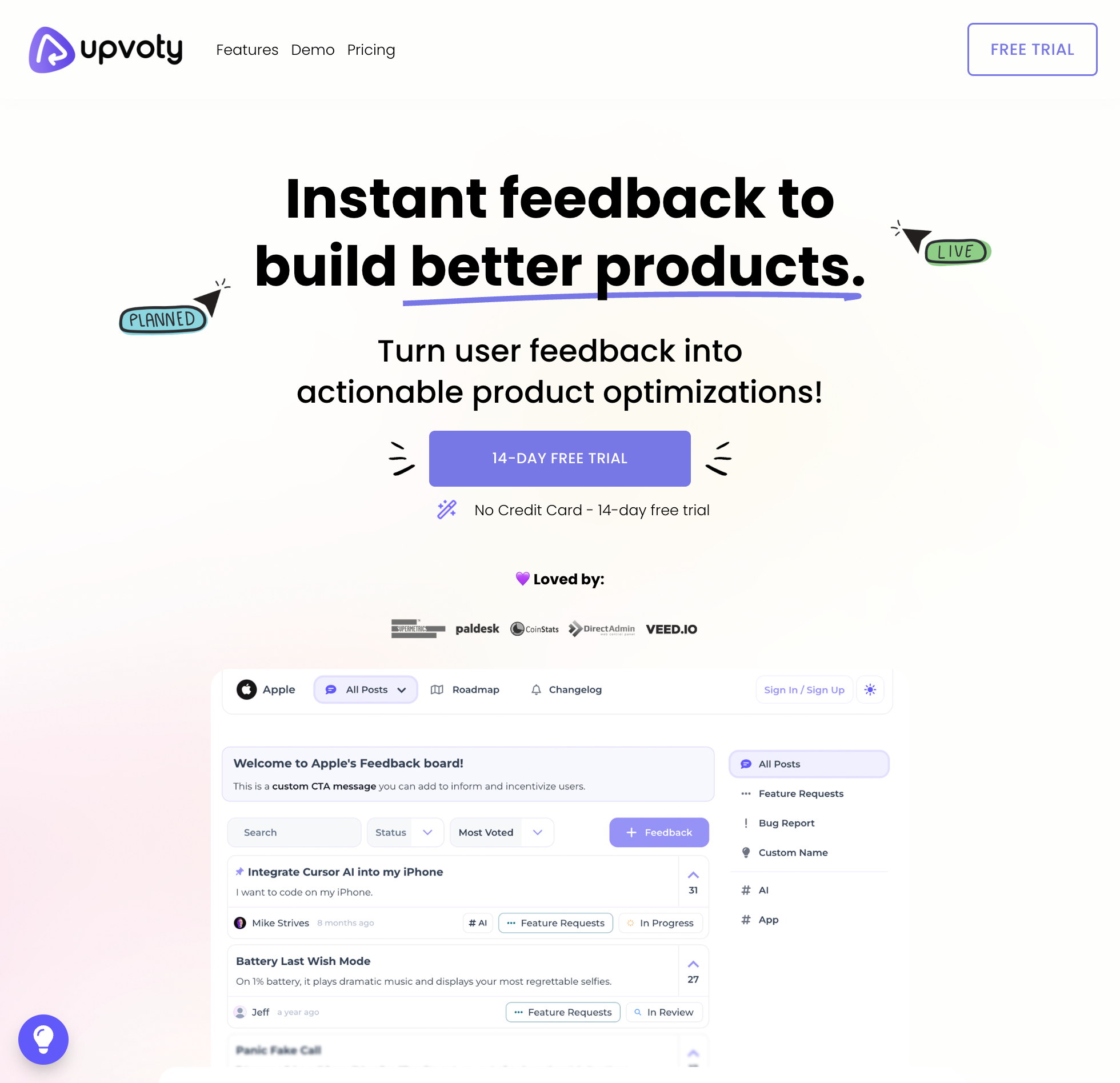
Upvoty starts at $15 a month on its Power plan after a 14-day trial, with no permanent free plan, and moved off tracked-user limits in 2025 so every tier now includes unlimited boards and voters. Power and the $25 a month Super plan each cover a single project, while Hyper at $49 a month unlocks unlimited projects.
The trade-off for that $15 entry price is how quickly everyday features push you onto the higher plans. Power gives you the feedback board, a public roadmap, a custom domain, bug reports with screenshots in the widget, and anonymous guest voting, while keeping Upvoty's branding on your portal. Publishing a changelog, removing Upvoty branding, or connecting Slack, Discord, Jira, Linear, Intercom, or Zapier requires upgrading to Super at $25 a month, and REST API access, webhooks, custom JWT single sign-on, and Upvoty's MCP server are locked to Hyper at $49 a month.
On the board itself, Upvoty includes Merge AI to combine duplicate requests and smart tags for categorizing incoming posts. Before you sign up, confirm what your tier includes directly in the pricing page plan grid rather than older help articles, because Upvoty's pricing page, API documentation, and help center describe a few entitlements differently, and its terms state that subscriptions renew automatically with non-refundable fees.
Best for: Solo founders and small teams who want a low paid entry price for a single project and don't need a free plan, a changelog, or API access on the starter tier. See our Upvoty alternatives comparison.
6. Sleekplan
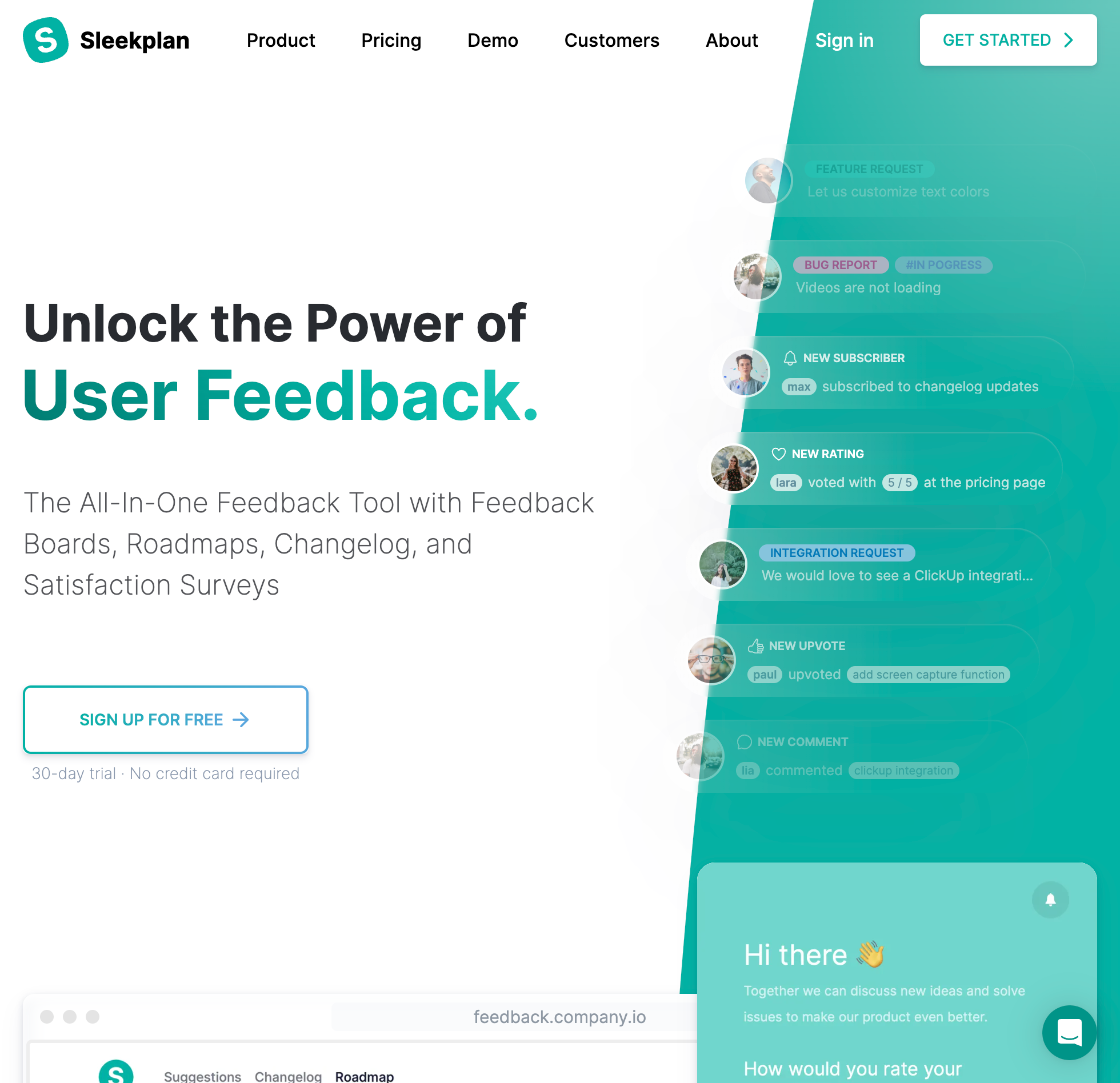
Sleekplan offers an ongoing free Indie plan with unlimited voters and posts, a feedback board, and a changelog for one admin seat, but it has held the public roadmap back for paid plans since mid-2026. Unlocking the roadmap, adding up to three admins, or turning on in-app surveys requires moving to Starter at $15 a month billed monthly, or $13 billed annually, while custom domains, branding removal, and user segmentation sit on Business at $45 a month, or $38 billed annually.
Instead of metering voters, Sleekplan meters what your workspace sends and displays each month. Every tier has monthly allowances for announcement views, survey popup deliveries, outbound emails, and AI credits. Free includes 500 emails and 1,000 announcement views a month with no AI, and status emails sent when a request ships count toward that email cap. On paid plans, AI actions like duplicate checks and spam detection draw from a monthly credit pool that stops running once your balance hits zero.
The product leans into bundling NPS and CSAT satisfaction popups into the same in-app widget as the feedback board, and admins can enable anonymous mode so visitors can vote without an account. If you test Sleekplan, check how its data exports work before your backlog grows: CSV downloads are capped at the newest 5,000 rows per dataset, including votes and comments, and the generated download links expire after 14 days.
Best for: Teams that want NPS and CSAT micro-surveys inside the same widget as their feedback board and can work within monthly email, view, and AI credit limits. See our Sleekplan alternatives comparison.
7. Fider
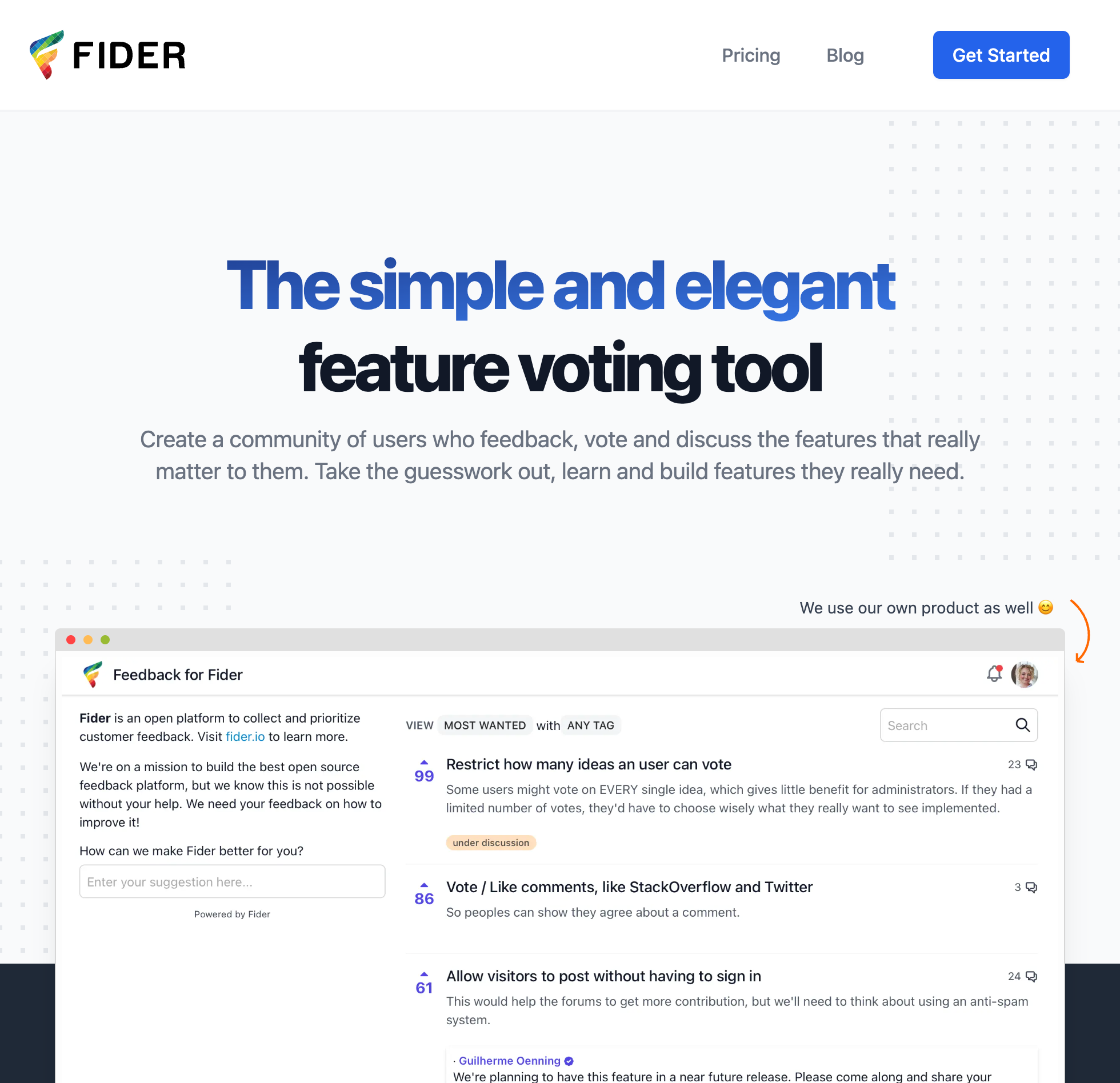
If your security policy says customer feedback cannot live on a third-party vendor's cloud, Fider is open source under the AGPL-3.0 license and runs on your own server with Docker and a Postgres database. Self-hosting is completely free and includes every feature in the codebase with no post limit, so your request data never leaves your infrastructure, though your team is responsible for provisioning the server, configuring SMTP for outbound email, and running database backups.
For teams that don't want to manage a server, Fider also sells a hosted version. Fider Cloud Free gives you unlimited voters and a custom domain, but caps your board at 250 feedback posts under a fair-use policy and puts a noindex header on every page so search engines won't index your board. Upgrading to Fider Cloud Pro at $25 a month per site removes the 250-post limit, unlocks post moderation and search indexing, and adds the three-column public roadmap that Fider shipped in June 2026.
Whether you self-host or pay for the cloud plan, Fider is strictly a standalone voting board and leaves out everything around it. There is no in-app widget, no dedicated changelog beyond filtering for completed posts, and no AI features, which Fider notes on its own blog is a deliberate design choice. Visitors must sign in with an email verification code or OAuth before they can vote, and clicking upvote does not subscribe the voter to status emails unless they also click a separate follow button on the thread. Support is handled over email with no dedicated support team and a published response window of up to 48 hours.
Best for: Technical teams that need to keep feature request data on their own servers and have an engineer available to maintain Docker, Postgres, and email delivery. See our Fider alternatives comparison.
8. Feature Upvote
Feature Upvote charges by the board rather than by the workspace or the voter. Its Indie plan costs $59 a month per board, or $49 a month billed annually, and Standard runs $119 a month per board, or $99 billed annually, to unlock SAML single sign-on, branding removal, custom CSS, and integrations with Jira, Microsoft Teams, and Zapier. Both tiers include unlimited contributors, team members, and votes on that board, and there is no permanent free plan after the 30-day trial.
The product stops at the voting board itself, without a roadmap or changelog around it. Feature Upvote's own comparison page notes that it has no dedicated roadmap view, leaving visitors to filter the suggestion list by status tags like Planned or Done, and its help center documents no release-notes tool. If you want to embed the board inside your web app, its documentation describes the JavaScript widget as a proof of concept that omits image uploads, moderation, and duplicate suggestions.
Where Feature Upvote keeps friction low is on participation. Visitors on a public board can click upvote without signing in, using browser cookies and rate throttling to deter vote stuffing, or submit a new suggestion with a name and email. Status-change emails are batched once a day rather than sent immediately, and lately the product has focused much of its positioning on game studios collecting player feedback in 19 languages.
Best for: Game studios and teams that want a single standalone voting board with guest voting and don't need a public roadmap, changelog, or in-app widget. See our Feature Upvote alternatives comparison.
9. Productboard
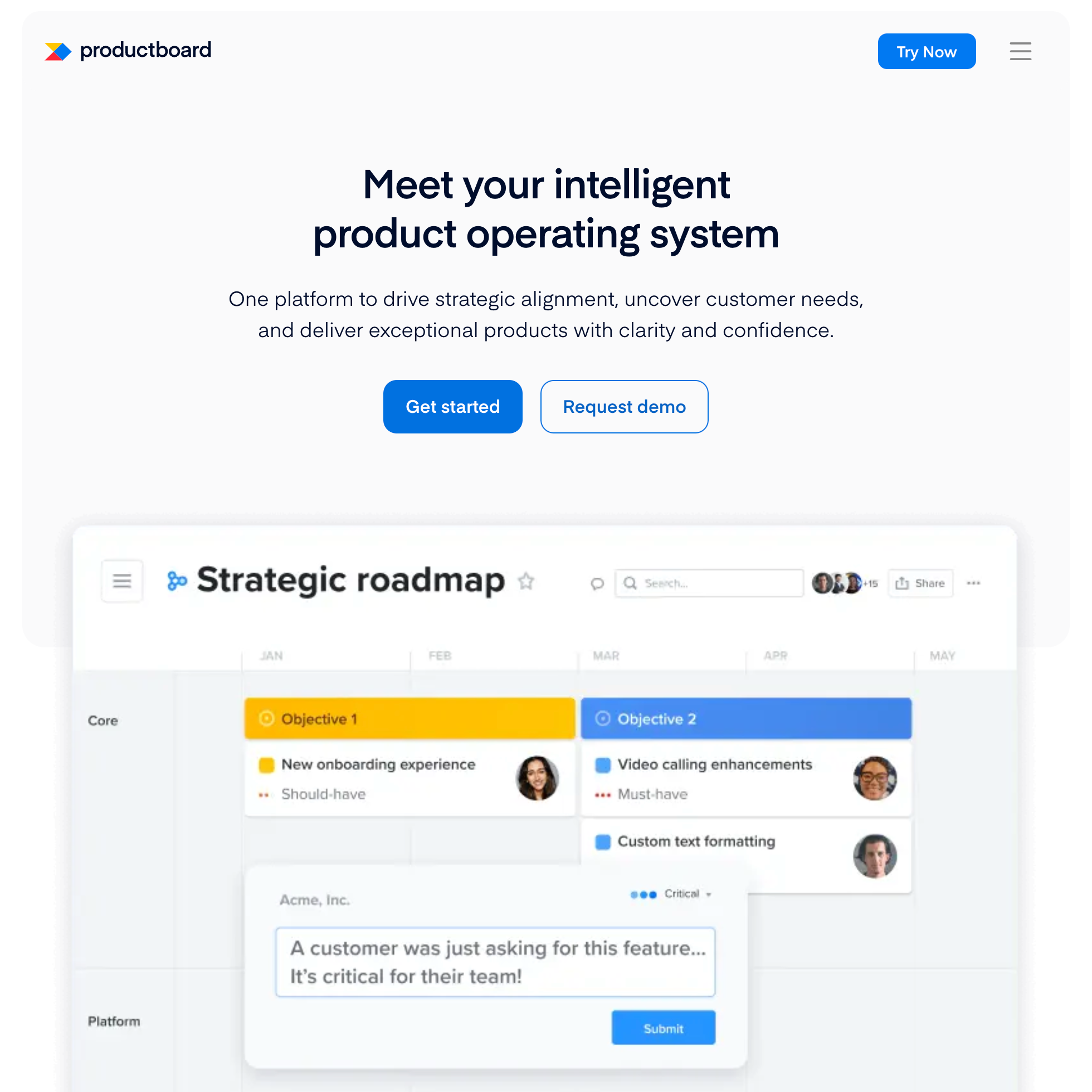
Unlike a public community board, Productboard's portal keeps submissions private to the customer who sent them. A visitor can verify their email, submit a request, and rate how important a curated card is to them, but they never see or vote on what other customers have requested, so the portal functions as a private intake form rather than a shared voting board.
That setup reflects what Productboard is built for: internal prioritization and roadmapping priced per "maker" seat. The free plan gives one maker a single portal, 500 lifetime feedback notes, and 25 contributors, while contributors who only submit feedback don't require a paid license on any tier. Moving to Plus costs $25 a maker a month, or $19 billed annually, and still keeps the 500-note lifetime cap until you jump to Business at $75 a maker a month, or $59 billed annually, with a two-maker minimum.
What you pay for on those maker seats is the internal planning layer, including weighted prioritization scoring, feature hierarchies, and linking customer notes to roadmap items. Embedding the portal inside your app and identifying users with a JWT require the Business plan, and removing Productboard's branding requires an Enterprise contract. Before committing years of research to it, check the export docs: Productboard's help center states there is no efficient way to export an entire workspace, and feedback CSVs leave out the body text of notes imported from Zendesk, Slack, and Intercom.
Best for: Product management teams that want internal prioritization matrices and a private customer intake portal and have the budget for per-maker seats. See our Productboard alternatives comparison and the Productboard pricing breakdown.
10. Jira Product Discovery
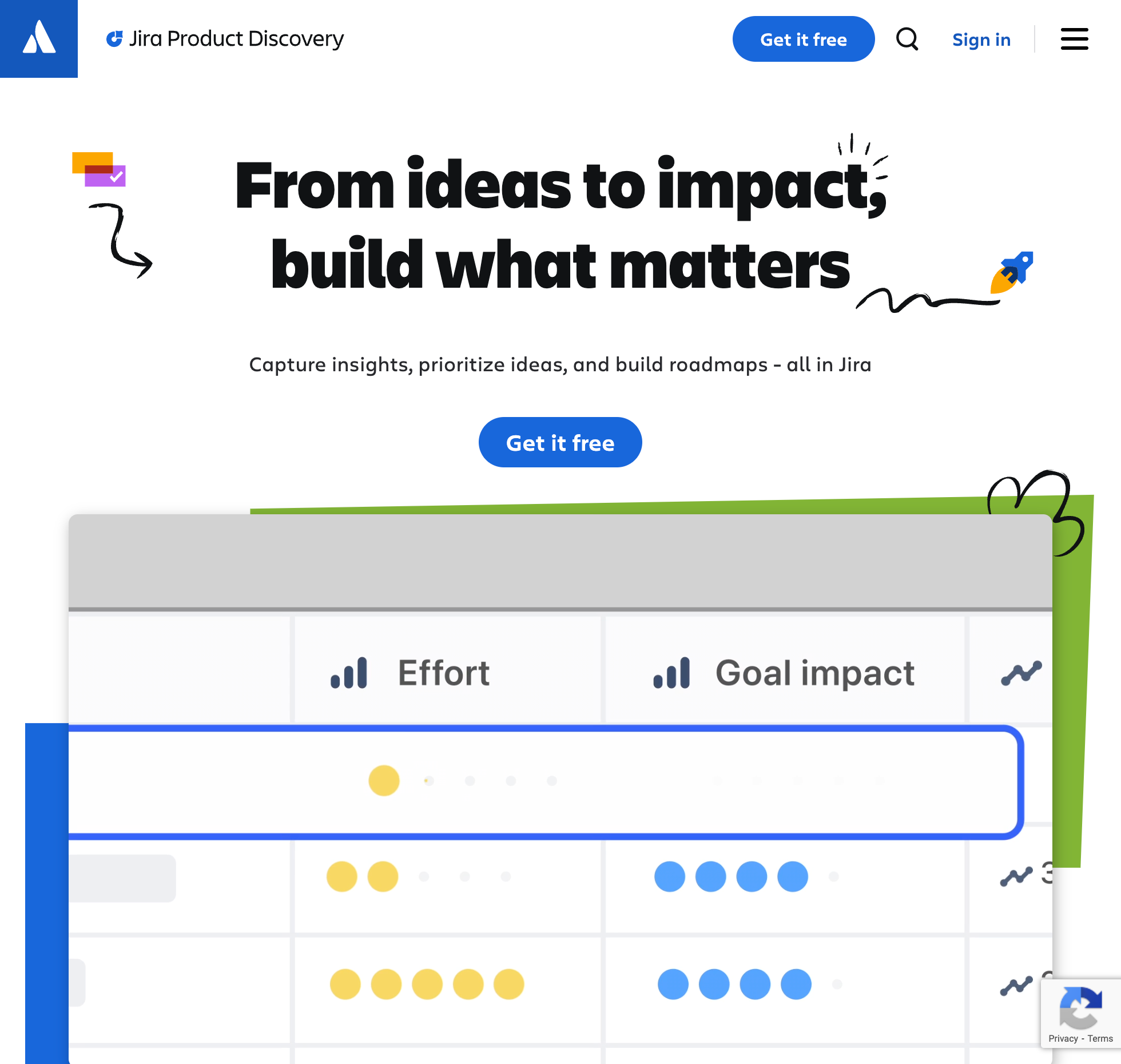
Jira Product Discovery is built for product teams whose engineering delivery already lives in Jira Software. Atlassian splits pricing between paid creators who edit ideas and build views and unlimited free contributors who comment and vote: Free covers up to three creators, Standard costs $10 a creator a month, and Premium is $25 a creator a month, with annual billing sold in seat bands starting at $500 a year for up to five creators on Standard. Monthly subscriptions bill for the highest creator count reached during the cycle, so removing a seat mid-month does not lower that month's invoice.
Despite showing up in searches for feature request tools, it is not a public customer voting board. Free contributors still need an Atlassian account and space permissions to submit ideas or vote, which is how support and sales teams feed requests into the backlog. While Standard and Premium let you share a published roadmap view link with anyone on the web, that page is strictly read-only, so external customers can look at the cards you expose but cannot upvote ideas, leave comments, or submit new requests.
Teams pick Jira Product Discovery for the two-way connection between an idea in discovery and the delivery epics in Jira Software, where engineering progress rolls back up to the idea view. Cross-project roadmaps, custom domains, view restrictions, and Atlassian's Rovo AI all sit on the $25 Premium tier, and there is no built-in changelog or in-app widget without pairing a separate tool like Usersnap. Standard CSV exports also carry only numeric insight counts rather than the full text of attached customer insights.
Best for: Product teams already on Jira who want to score and track ideas internally right next to their delivery tickets and don't need a public customer voting board. See our Jira Product Discovery alternatives comparison and the Jira Product Discovery pricing guide.
Which feature request tool should you pick
If your customers are the ones asking for features, pick a public board where they can see what others have requested, add their vote, and watch items move across the roadmap. UserJot, Canny, Frill, Nolt, Upvoty, Sleekplan, and Feature Upvote all work that way, and the practical difference between them comes down to what the billing meter counts and how much of the feedback loop sits around the board. Among those options, UserJot is the only one with an uncapped free plan that includes the feedback board, public roadmap, changelog, in-app widget, and support inbox together.
If your internal product team is the primary audience, Productboard and Jira Product Discovery are built for internal scoring and roadmapping at a per-seat price. Productboard pairs its planning workspace with a private customer intake portal, while Jira Product Discovery takes ideas from colleagues who have an Atlassian account and links them directly to Jira issues. And if a security policy says customer requests cannot leave your own infrastructure, Fider is the open-source option to self-host.
Choosing the software is the easy part of the job. Once requests start piling up in one place, the real work is prioritizing feature requests without letting the loudest account on yesterday's call hijack your roadmap, and knowing how to respond to feature requests with a clear answer whether you're building the idea, declining it, or still weighing the trade-offs.
Frequently asked questions
What is a feature request tool?
A feature request tool gives customers one place to submit ideas for your product, vote on what other people have asked for, and see what your team decided to build. Most tools pair a public voting board with a roadmap showing what is planned and in progress and a changelog announcing what shipped. Without one, requests end up scattered across support tickets, Slack threads, and spreadsheets where votes are impossible to tally and customers never hear back when a feature goes live.
What is the best feature request tool for a SaaS company?
UserJot is the best feature request tool for most SaaS teams because it includes a public board, roadmap, changelog, in-app widget, and support inbox at a flat workspace price, with a permanent free plan that has no cap on users or posts. Canny is the main alternative if your workflow requires native Jira or Salesforce sync and your budget can scale with your voter count. Teams that want internal roadmap prioritization rather than public customer voting usually pick Productboard or Jira Product Discovery.
Is there a free feature request tool?
Yes, though you should check what each free tier leaves out before committing. UserJot's free plan never expires and includes the feedback board, public roadmap, changelog, widget, and support inbox in beta with no cap on users or posts. Sleekplan's free plan leaves out the public roadmap, Canny's stops accepting new participants after 25 tracked users vote or comment, and Fider's hosted free plan caps you at 250 posts unless you self-host the open-source build yourself.
Can customers vote without creating an account?
On most of the public boards on this list, yes, once an admin turns on guest or anonymous voting in settings. UserJot supports posting and voting without an account starting on the $29 a month Starter plan, and Frill, Nolt, Upvoty, Sleekplan, and Feature Upvote also allow guest voting. By contrast, Canny documents no way for a visitor to vote without signing in or being identified by your app, Fider requires an account, Productboard asks for a verified email, and Jira Product Discovery does not allow external visitor voting at all.
How much should a feature request tool cost?
A flat-rate feature request board for a small or mid-sized SaaS team costs between $0 and $59 a month on UserJot, or $15 to $89 a month on tools like Upvoty and Nolt. What matters more than the starting price is what makes the bill climb: a tracked-user plan like Canny's starts at $79 a month billed yearly for 100 voters and passes $500 a month once 1,000 customers have voted, while per-seat suites grow with every product manager you hire. On a flat workspace plan, a popular feature request costs you nothing extra.
Should the feature request board be public or private?
A public board is the better default for a SaaS product with a self-serve user base, because customers can find existing requests and upvote them instead of filing duplicates, and the vote counts show you which problems come up most often. Private boards make sense when enterprise accounts don't want competitors seeing what they asked for. UserJot lets you run both public and private boards in the same workspace starting on the $29 Starter plan, while Productboard keeps portal submissions private to each sender on every plan.
How do I stop getting duplicate feature requests?
The best way to prevent duplicates is showing customers similar requests before they finish typing a new one. UserJot runs embedding search as a user types on the board or in the widget to surface matching threads immediately, and admins can merge any duplicates that still slip through so the votes and comments combine without double-counting. On tools without search-as-you-type, your team has to spot and merge duplicates manually.
What happens when a feature request ships?
Your tool should close the loop with everyone who asked for the feature automatically. On UserJot, changing a request's status to Completed emails the author, every voter, and every commenter, and your changelog post can link right back to the requests it closes. Not every tool notifies voters automatically: on Fider, only the post author is subscribed by default, so voters never hear that a feature shipped unless they clicked a separate follow button on the thread.
Can I move my feature requests to a different tool later?
Every tool on this list documents a data export, though the limits vary enough that you should check them before migrating years of feedback. UserJot lets you export all posts as a CSV on every plan and includes built-in importers for Canny, Nolt, and ProductRoad alongside AI-mapped CSV import for everything else. Watch out for row caps and omitted fields on other tools: Sleekplan limits CSV exports to the newest 5,000 rows per dataset, and Productboard's help docs state there is no efficient way to export an entire workspace at once.