Canny Pricing 2026: Is It Worth It? Calculator + Cheaper Alternatives
Shayan, FounderUpdated 23 min read

Canny's pricing page starts at $0 on Free for up to 25 tracked users total, and its self-serve Pro plan starts at $79 a month on annual billing or $99 a month on monthly billing for 100 tracked users. From there, the price climbs in steps alongside your user count: at 500 tracked users, Pro costs $279 a month billed yearly or $349 a month monthly; at 1,000 tracked users, it runs $529 a month billed yearly or $661 a month monthly; and at 5,000 tracked users, it reaches $1,079 a month billed yearly or $1,349 a month monthly before pushing you onto a custom annual Business contract. Paid plans also offer a 14-day free trial with no credit card required.
If you're looking at older quotes, legacy accounts, or pricing calculators that start at $19 a month billed yearly or $24 a month monthly, those numbers come from Canny's Core plan. Canny introduced Core in May 2025 at $19 to $24 for 100 tracked users, scaling up to $311 a month at 1,000 tracked users and $656 a month at 5,000 tracked users, and then quietly removed Core from its public pricing page for new signups in June 2026.
The reason Canny bills end up so much higher than the entry price on the card is the unit Canny meters. Instead of charging for your internal team seats, Canny bills per workspace based on cumulative "tracked users." Every customer who ever submits a post, clicks upvote, leaves a comment, or has feedback logged on their behalf by your team or Canny's Autopilot AI adds to that count, and the meter doesn't reset at the end of the month. One popular feature request that gets shared in your community and brings in a few hundred upvotes can push a workspace from $99 a month into the $349 or $661 tier overnight.
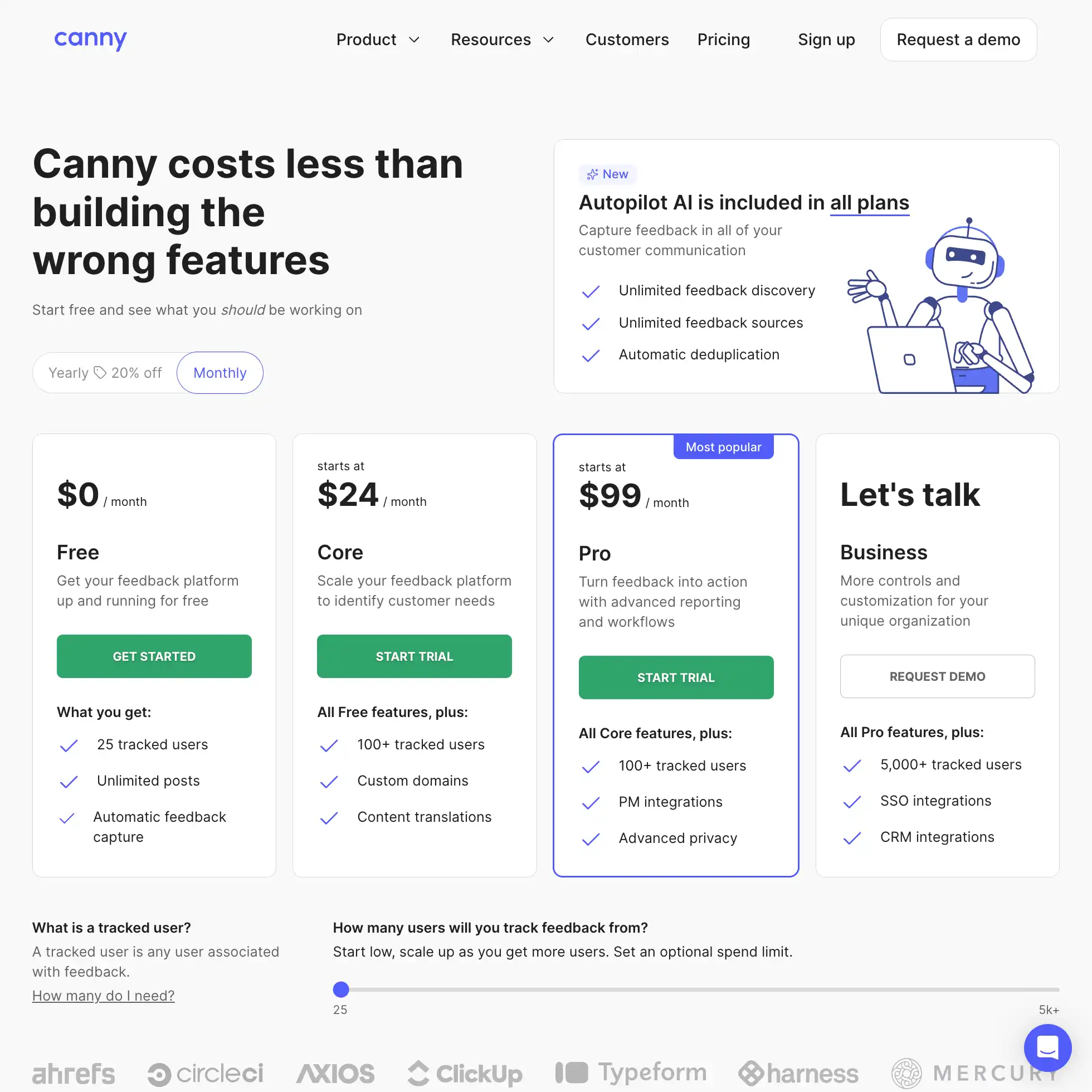
Canny pricing plans
Today, Canny sells three plans to new customers: Free, Pro, and Business, while existing accounts that signed up between May 2025 and June 2026 may still sit on the retired Core tier. Every workspace is billed separately, and every plan includes unlimited feedback posts, unlimited boards, and unlimited read-only Contributor seats for internal teammates. What changes from plan to plan is your tracked-user allowance, the number of Manager seats, and which integrations and privacy controls are unlocked.
| Feature | Free | Core, retired mid-2026 | Pro | Business |
|---|---|---|---|---|
| Monthly billing | $0 | $24 to $656/mo | $99 to $1,349/mo | Custom quote |
| Annual billing | $0 | $19 to $525/mo | $79 to $1,079/mo | Custom annual |
| Tracked users | 25 total | 100 to 5,000 | 100 to 5,000 | 5,000+ custom |
| Manager seats | 5 | 5 | 10 | Custom |
| Posts and boards | Unlimited | Unlimited | Unlimited | Unlimited |
| Autopilot discovery | Included | Included | Included | Included |
| Custom domain | No | Yes | Yes | Yes |
| Internal comments | No | No | Yes | Yes |
| PM integrations | No | No | Jira, Linear, GitHub | Jira, Linear, GitHub |
| Admin SSO | No | No | No | Okta, OIDC, Entra ID |
| Remove Canny brand | No | No | No | Paid add-on |
| HubSpot & Salesforce | No | No | No | Paid add-on |
Free: $0 for up to 25 tracked users
Canny's Free plan is an ongoing tier rather than a 14-day trial, and on paper it includes a wide set of features: five Manager seats, unlimited boards and posts, a public roadmap, a changelog, admin-only private boards, the in-app widget, API and webhook access, Slack and Discord notifications, and Autopilot feedback capture from Intercom and Zendesk.
The wall that stops almost every real software product on Free is the 25 tracked-user cap. Because Canny counts every person who ever votes, comments, or posts across the lifetime of your workspace, 25 tracked users is a ceiling most live apps cross in their first week. Free also requires completing a seven-day onboarding checklist, which includes collecting feedback from five participants, or messaging support to keep the free workspace unlocked.
Core: $19 annual or $24 monthly for 100 tracked users, retired for new signups
Between May 2025 and June 2026, Canny offered Core as a middle step for small teams that outgrew 25 users and needed a custom domain like feedback.yourcompany.com without paying for project management integrations. Core started at $19 a month billed yearly or $24 a month monthly for 100 tracked users, rose to $156 a month monthly at 500 tracked users, $311 a month at 1,000 tracked users, and topped out at $656 a month at 5,000 tracked users.
Even on Core, teams were locked out of internal admin comments, custom statuses, user segmentation, and Jira, Linear, or GitHub sync. In June 2026, Canny pulled Core off its pricing page, so new workspaces outgrowing the 25-user Free limit now have to jump straight to Pro.
Pro: $79 annual or $99 monthly starting at 100 tracked users
Pro is now Canny's entry paid plan for new signups, starting at $79 a month billed yearly, which is $948 paid upfront, or $99 a month month-to-month for your first 100 tracked users.
Upgrading to Pro raises your workspace from five Manager seats to ten and unlocks the workflow tools most product teams actually buy Canny for: custom domains, private internal comments for your team, custom post statuses, user and company segmentation, and project management integrations with Jira Cloud, Linear, GitHub, ClickUp, Asana, and Azure DevOps. Pro also turns on Canny's MCP server, Zapier and Segment connections, AI Smart Replies, and changelog subscriber emails.
Business: custom annual pricing for 5,000+ tracked users
Once your workspace passes 5,000 tracked users, or if your security team requires admin single sign-on through Okta, OIDC, OneLogin, or Microsoft Entra ID, Canny moves you off self-serve billing onto a sales-assisted Business contract. Business requires an annual commitment, lets you pay by invoice or bank transfer, adds custom admin roles and view-sharing permissions for Canny Ideas, and includes a dedicated customer success manager.
What surprises many buyers on Business is that several high-ticket items are still not included in the base Business subscription. On Canny's pricing matrix, removing the "Powered by Canny" badge, white-labeling outbound emails, connecting HubSpot or Salesforce revenue data, and completing a custom security review are all marked as separate paid add-ons on top of the Business contract.
How Canny's tracked-user meter and rate tiers work
In May 2025, Canny switched from charging per admin seat to charging per tracked user. Under this model, simply identifying a logged-in user through the Canny SDK or having someone subscribe to changelog emails doesn't add to your bill. A person becomes a tracked user the moment any feedback activity is attributed to them, whether they submit a new post on your portal or widget, click upvote on an existing idea, or write a comment on a thread. They also become a tracked user if a teammate logs a vote or post on their behalf through the dashboard, Chrome extension, Slack, or API, or if Canny's Autopilot AI extracts feedback from a support ticket or sales call and attaches it to their profile.
If one customer votes on twelve different posts and leaves four comments, they still count as a single tracked user. Your own admins and managers also count as tracked users if they post, vote, or comment on your boards.
The catch is that your tracked-user total is cumulative rather than a monthly active user count, so it doesn't reset to zero on the first of the month. Whether closing or completing old feature requests lowers your count is unresolved even in Canny's own documentation: one section of Canny's tracked-user help article states that post status doesn't matter, while another paragraph on the exact same page says a user stops counting when their post is marked closed or completed unless they interacted with another open post. Because Canny's current pricing page removed the old "active posts" qualifier, you shouldn't count on shipping or closing features to shrink your monthly invoice.
Here is the published rate ladder for Canny's Pro plan across both monthly and annual billing, alongside the retired Core rates that many legacy accounts still pay:
| Tracked users | Core monthly, retired | Pro monthly | Pro annual, monthly rate | Pro annual total |
|---|---|---|---|---|
| 25 or fewer | $0 on Free | $0 on Free | $0 on Free | $0 |
| 100 | $24/mo | $99/mo | $79/mo | $948/yr |
| 200 | $61/mo | $161/mo | $129/mo | $1,548/yr |
| 300 | $94/mo | $224/mo | $179/mo | $2,148/yr |
| 400 | $124/mo | $286/mo | $229/mo | $2,748/yr |
| 500 | $156/mo | $349/mo | $279/mo | $3,348/yr |
| 700 | $219/mo | $474/mo | $379/mo | $4,548/yr |
| 1,000 | $311/mo | $661/mo | $529/mo | $6,348/yr |
| 1,500 | $374/mo | $786/mo | $629/mo | $7,548/yr |
| 2,000 | $436/mo | $911/mo | $729/mo | $8,748/yr |
| 2,500 | $499/mo | $1,036/mo | $829/mo | $9,948/yr |
| 3,000 | $531/mo | $1,099/mo | $879/mo | $10,548/yr |
| 4,000 | $594/mo | $1,224/mo | $979/mo | $11,748/yr |
| 5,000 | $656/mo | $1,349/mo | $1,079/mo | $12,948/yr |
Going from 100 to 1,000 tracked users multiplies a monthly Pro bill by 6.7x, from $99 to $661 a month, and multiplies a legacy Core bill by nearly 13x, from $24 to $311 a month. Canny estimates on its own pricing FAQ that 1% to 5% of a B2B SaaS product's total users typically become tracked users, which means a product with 25,000 users over a couple of years can easily accumulate 500 to 1,250 tracked users on its board.
By default, if your workspace crosses into the next tracked-user tier mid-month without a spend limit set, Canny automatically moves your subscription up to the next bracket and bills a prorated charge for the remainder of your billing cycle. You can turn on a hard spend limit in your billing settings to prevent surprise upgrades, but when you hit that cap, Canny stops tracking feedback from any new users and Autopilot pauses analyzing new support conversations until you raise the ceiling.
Calculate Your True Cost
See how much you'll actually pay as you grow.
Canny AI pricing and paid add-ons
Unlike help desks that charge $0.75 to $2.00 every time a bot answers a chat, Canny doesn't charge a per-resolution fee on its current plans. Instead, AI usage feeds directly into your tracked-user meter and tier gates.
Autopilot discovery and deduplication: included, but feeds your user meter
Every current Canny plan, including Free, comes with unlimited Autopilot sources and feedback discovery. You can connect Intercom, Zendesk, Help Scout, Freshdesk, Gong, Zoom, Google Meet, Fireflies, Fathom, or Grain, and Autopilot will scan closed support tickets and call transcripts to extract feature requests and merge duplicates automatically.
The hidden cost of Autopilot is how attribution works. Whenever Autopilot pulls an insight out of an Intercom chat or a recorded sales call and attaches it to that customer's profile in Canny, that person becomes a tracked user. Turning on automatic capture across a busy support inbox can burn through your 100 or 500 tracked-user allowance in weeks, even if few customers ever visit your public feedback portal directly. Note that Autopilot also pauses if your inbox accumulates 100 pending suggestions waiting for admin review.
If your workspace is still on a grandfathered pre-May 2025 legacy plan such as Starter or Growth, Autopilot still runs on a separate credit meter instead of unlimited discovery. Legacy plans include 25, 100, or 500 monthly credits with no rollover, and extra credits cost $0.10 each in 100-credit blocks for $10. One text ticket, duplicate check, Smart Reply, or comment summary uses one credit, and each audio call recording uses five credits.
Smart Replies, comment summaries, Themes, and MCP: gated to Pro
While basic feedback capture is on Free, the rest of Canny's AI suite requires upgrading to Pro at $79 to $99 a month minimum. Pro unlocks Smart Replies, which posts automated follow-up questions when a user submits a vague request, Comment Summaries for threads with more than ten comments, and AI Themes for grouping ideas by topic over a 12-month window. Pro is also required if you want to connect Canny's remote MCP server to Claude, ChatGPT, Cursor, or Codex.
Branding removal, email white-labeling, and CRM sync: Business add-ons
If you want your feedback portal and widget to look like part of your own product without a vendor badge in the footer, you can't buy branding removal on Free or Pro at any tracked-user volume. Removing the "Powered by Canny" link and sending status emails from your own white-labeled domain are both locked behind the custom Business plan, and both are billed as extra add-ons on top of the Business base contract. The same rule applies to native HubSpot and Salesforce integrations for tying MRR and deal pipeline to feature requests.
What Canny actually costs at 100, 500, 1,000, and 2,500 tracked users
To see what a growing software team actually pays over a year, the table below compares Canny's monthly and annual Pro rates, along with the retired Core rates, against UserJot's flat workspace pricing at four common engagement milestones.
| Tracked users | Canny Core, monthly | Canny Pro, monthly | Canny Pro, annual | UserJot | Annual savings vs Canny Pro |
|---|---|---|---|---|---|
| 100 | $24/mo | $99/mo | $79/mo | $29/mo | $600 to $840/yr |
| 500 | $156/mo | $349/mo | $279/mo | $29/mo | $3,000 to $3,840/yr |
| 1,000 | $311/mo | $661/mo | $529/mo | $29/mo | $6,000 to $7,584/yr |
| 2,500 | $499/mo | $1,036/mo | $829/mo | $59/mo | $9,240 to $11,724/yr |
For an early-stage startup launching a beta with 50 active testers, you pass Canny's 25-user Free ceiling as soon as half of your testers upvote a single roadmap card. On the current pricing page, that 26th voter forces a decision between capping your board so new users stop being tracked or paying $79 a month billed yearly, or $99 monthly, for the 100-user Pro tier.
For a growing B2B SaaS team with 500 engaged users over its first year or two, Canny Pro runs $279 a month on annual billing or $349 a month on monthly billing, which comes out to $3,348 to $4,188 a year. If your product has a healthy community or you share a roadmap link in your release notes and reach 1,000 tracked users over time, the same Pro workspace jumps to $529 a month billed yearly or $661 a month monthly, or $6,348 to $7,932 a year.
That one-way meter is the main reason longtime customers end up looking for an exit. In February 2026, updown.io founder Adrien Rey-Jarthon published a detailed post explaining why he migrated away from Canny after his renewal quote jumped, noting that tracked users are "a metric that will only go up even if you stay a small business." Even if your company size and monthly revenue stay flat, every new customer who clicks upvote on an old thread pushes your workspace closer to the next billing bracket.
What changed in 2025 and 2026: tracked users, legacy Free retirement, and Core removal
If you have used Canny in the past or read older reviews, Canny's pricing has gone through three major shifts between May 2025 and mid-2026.
First, in May 2025, Canny retired its older seat-based plans, where Starter cost $79 a month and Growth cost $359 a month billed yearly with unlimited end users, and switched to the current tracked-user model. Existing paid Starter and Growth customers who signed up before May 9, 2025 were grandfathered into their old plans, while all new accounts moved onto the 25-user Free tier, Core, or Pro.
Second, on November 19, 2025, Canny emailed everyone still on a legacy Free plan to announce that legacy Free accounts were being retired on December 15, 2025.

Teams that had accumulated more than 25 tracked users over the years were given until December 15 to upgrade to a paid tracked-user plan, with a 20% discount offered if they upgraded before November 30. For workspaces that did not upgrade by the deadline, Canny kept their public boards visible and allowed end users to keep submitting posts, but locked the team out of admin access until they paid for their accumulated user tier.

Canny is forcing me from their free plan to $219/mo 😮 Been using Canny happily for years, but this is more than I pay to host the servers to run Pallyy! Any alternative recommendations?
Third, in June 2026, Canny removed the $19-to-$24 Core plan from its pricing page and made Canny Ideas, its five-level internal planning hierarchy of Groups, Subgroups, Ideas, Sub-ideas, and Insights, the default workspace experience. Removing Core raised the entry price for any new workspace with 26 or more tracked users from $19 a month billed yearly to $79 a month billed yearly on Pro.
Contract terms, discounts, and renewal fine print
Before you put down a card or commit to an annual Pro or Business plan, four details in Canny's billing documentation and terms of service are worth knowing up front.
First, annual plans and mid-cycle upgrades are non-refundable. Subscriptions renew automatically in advance, and Canny's terms state that refunds are handled solely at the company's discretion on a case-by-case basis, with no general money-back guarantee. When your workspace crosses a tracked-user tier without a spend limit enabled, Canny upgrades your plan immediately and charges a prorated amount for the rest of the cycle.
Second, the old $100 startup plan is gone, and referral discounts only work on brand-new accounts. Back in 2024, Canny advertised a Startup program giving 75% off Growth in year one and 50% off in year two. Today, Canny no longer lists a public startup discount on its pricing or billing pages, offering custom discounts only on inquiry for qualified nonprofits and high-volume B2C apps with low revenue per user. Canny does maintain a referral link program that takes 20% off a monthly plan for three months or 5% off your first annual year, but you have to sign up within seven days of clicking the referral link, and existing Free workspaces upgrading to paid are excluded.
Third, downgrading to Free drops your custom domain. Workspace owners can cancel a self-serve Pro plan or downgrade back to Free from billing settings, with paid features staying active through the end of the current billing period. However, moving down to Free requires complying with Free's 25-user and feature limits, which means your feedback.yourcompany.com custom domain stops working and your portal reverts to a *.canny.io subdomain.
Fourth, check what your CSV export includes before you cancel. Any Canny plan lets you export your feedback posts and vote lists to CSV, and you can pull full user emails, votes, and comments through the public API. Inside the dashboard UI, however, downloading a CSV of comments is gated to the Business plan, and exporting from Canny Ideas caps each CSV file at 10,000 rows while omitting individual customer insight text and source URLs.
Is Canny worth it?
Canny is worth the money when you have a dedicated product operations workflow and a budget built for per-user scaling. If your team wants Autopilot to ingest feature requests automatically from Intercom, Zendesk, and Gong calls, organize them inside a five-level Ideas hierarchy with custom weighted impact-versus-effort formulas, sync statuses two ways with Jira Cloud or Azure DevOps, and tie requests to Salesforce or HubSpot deal values on a Business contract, Canny has spent years building for that enterprise setup. Reviewers on G2 and Capterra consistently praise how well Autopilot and the Jira and Intercom integrations pull scattered feedback into one place.
For most startups and software teams, the math pulls in the opposite direction.
When you build a SaaS product, you want as many users as possible visiting your board, upvoting ideas, and telling you what hurts. On Canny, every user who participates becomes a permanent line item on your bill, and you can't even let visitors post or vote without an account unless you identify them through your app or require a login. Paying $349 to $661 a month just because 500 or 1,000 customers upvoted feature requests over the last two years means your feedback software can end up costing more than the servers running your product.
Canny alternatives
UserJot


We built UserJot for software teams that want a clean public feedback board, product roadmap, and changelog without a tracked-user meter punishing them when customers show up to vote.
Instead of charging for every voter or commenter, UserJot charges a flat workspace price of $0, $29, or $59 a month with unlimited end users and unlimited posts on every plan. Whether 50 people vote on your roadmap or 50,000 do, your monthly bill never changes.
When a user starts typing a feature request on your board or inside the in-app widget, UserJot runs embedding search to surface similar existing requests in real time so users upvote the existing thread instead of creating duplicates. When you move a request to Planned or In Progress, it appears on your public roadmap automatically. When you ship the feature and mark the request Completed, UserJot automatically emails everyone who posted, voted, or commented on it, and Juno, our AI assistant inside the changelog editor, can read your newly completed requests and draft the release note for you to edit and publish. UserJot also includes live chat and a shared support inbox, currently in beta and free on every plan while in beta, where Juno answers routine support questions from your docs and can search your feedback board right inside the chat thread to file a request or add a customer's vote once they confirm.
| Tracked users | Canny Pro, annual | Canny Pro, monthly | UserJot |
|---|---|---|---|
| 100 | $79/mo | $99/mo | $29/mo |
| 500 | $279/mo | $349/mo | $29/mo |
| 1,000 | $529/mo | $661/mo | $29/mo |
| 2,500 | $829/mo | $1,036/mo | $59/mo |
UserJot's Free plan is permanent and includes unlimited end users and posts, two feedback boards, three admin seats, the public roadmap, the changelog, the in-app widget, and Conversations in beta. Starter at $29 a month covers up to 100 admins and five boards, and unlocks a custom domain like feedback.yourcompany.com, private boards where a signed-in customer sees only their own requests while your team sees all of them, a moderation approval queue, and automatic login from your app onto the board. The REST API and our MCP server for Claude Code, Cursor, Codex, and ChatGPT desktop are on every plan, including Free, so an agent or integration works from day one without paying. Professional at $59 a month covers up to 100 boards and adds single sign-on where your server signs a JWT, public identity masking, and the option to remove the "Powered by UserJot" badge.
We also keep a clear boundary around what UserJot doesn't build. We connect to Slack, Discord, an email-to-feedback address, a REST API, and an MCP server, and we intentionally don't build native Jira, Linear, or Salesforce sync or a five-level internal planning hierarchy. If your team needs two-way Jira sync and Salesforce opportunity rollups inside your feedback tool, Canny is built for that. If you want a fast feedback board, roadmap, changelog, and support inbox at a flat monthly price, see our full Canny alternative comparison.
If you're already on Canny, switching takes about two minutes with our built-in Canny importer, available on every plan including Free. You paste your Canny API token into UserJot under Data & Import, review how your boards and statuses map on one screen, and click Start Import. UserJot pulls over your posts, votes, comments, attached images, and changelog entries in the background while keeping authorship and votes tied to each user by email, with zero downtime. You can walk through the exact steps in our Canny migration guide.
Escape Canny's pricing before your next renewal. Unlimited users, predictable costs.
UserJot keeps feedback, roadmap, and changelog in one simple loop.
Other feedback tools to compare
If you are comparing several feedback and roadmap tools alongside Canny, here is how the other major options structure their pricing and limits:
Productboard is an internal prioritization and roadmapping suite that bills per "maker" seat rather than per tracked voter, with a five-maker minimum across Business and Enterprise, no prices shown, and no Free or Plus plan on its pricing page. Unlike a public community board, its portal keeps submissions private to the customer who sent them, so visitors can't see or vote on each other's raw requests, and Productboard documents no standalone changelog product. See Canny vs Productboard, Productboard pricing, and our Productboard alternatives guide.
Nolt skips the free tier and charges per feedback board after a 10-day trial: $29 a month billed yearly or $39 monthly on Essential for a single board, and $69 billed yearly or $89 monthly on Pro for up to five boards. It does not meter voters or internal seats, allows guest voting without an account when enabled, and includes direct integrations with Jira, Linear, and GitHub even on the single-board plan. See our Nolt alternatives comparison.
Sleekplan starts with a $0 Free plan for one admin that includes a feedback board and changelog but leaves out the public roadmap and all AI features. Its paid plans cost $13 or $38 a month billed yearly, or $15 or $45 monthly, and bundle NPS and CSAT micro-surveys into the same widget while metering announcement views, survey popups, and monthly emails. Note that Sleekplan caps CSV data exports at the newest 5,000 rows per dataset, with download links that expire after 14 days. See our Sleekplan alternatives page.
Fider is an open-source voting board under the AGPL-3.0 license that you can self-host for free on your own server with Docker and Postgres, or run on Fider's hosted cloud for $25 a month per board on Pro after a 250-post non-indexed Free plan. It is strictly a feature voting board with no dedicated changelog product, no in-app widget, and no AI capabilities. See our Fider alternatives page.
Aha! Ideas charges $39 per seat a month billed yearly or $49 monthly with a three-seat minimum and no free plan, putting the entry price at $1,404 a year after a 30-day trial. Every internal teammate who accesses the workspace needs a paid seat, including colleagues who only view ideas, and it is designed primarily for teams that already plan their sprints inside Aha! Roadmaps. See Aha! pricing and our Aha! Ideas alternatives guide.
UserVoice publishes three plans from $1,000 a month billed yearly for 20 admins, or $12,000 a year, with unlimited portal users, no free plan, and an onboarding timeline its pricing page estimates at four to six weeks. It is built for large enterprise product teams routing feedback from Salesforce and Zendesk, though its help center still puts the public roadmap on an older Premium tier, and it is view-only for visiting customers. See UserVoice pricing and our UserVoice alternatives comparison.
You can compare all eight platforms side by side in our guides to the best customer feedback tools for B2B SaaS and free customer feedback tools.
Frequently asked questions
How much does Canny cost per month in 2026?
Canny has a $0 Free plan capped at 25 tracked users total, and its self-serve Pro plan starts at $79 a month billed yearly or $99 a month billed monthly for 100 tracked users. As more users vote or comment, Pro scales to $279 a month yearly or $349 monthly at 500 tracked users, $529 yearly or $661 monthly at 1,000 tracked users, and $1,079 yearly or $1,349 monthly at 5,000 tracked users. Above 5,000 tracked users requires a custom annual Business contract.
How does Canny calculate tracked users?
A tracked user is any person with a post, vote, or comment attributed to them, including feedback logged on their behalf by an admin or extracted from support conversations by Canny's Autopilot AI. Merely identifying a user with the Canny SDK or having someone subscribe to changelog emails does not make them a tracked user until they interact with feedback. If one person votes on ten different posts, they still count as one tracked user, and your total does not reset at the end of the month.
What happened to Canny's $24 Core plan and legacy Free plan?
Canny retired its legacy Free plans on December 15, 2025, requiring any legacy Free workspace with more than 25 tracked users to upgrade to a paid plan to keep admin access. Then in June 2026, Canny removed the entry-level Core plan, which started at $19 a month billed yearly or $24 a month monthly for 100 tracked users, from its public pricing page. New signups outgrowing the 25-user Free plan now start on Pro at $79 a month billed yearly or $99 monthly.
What happens when I exceed my tracked user limit on Canny?
On paid plans, if you have no spend limit enabled, crossing into the next tracked-user bracket triggers an automatic tier upgrade and a prorated charge for the rest of your billing period. If you turn on a spend limit in your billing settings, Canny stops tracking feedback from any additional users once you hit your cap, and Autopilot pauses analyzing new support tickets until you raise the limit.
Does closing or completing a post reduce my Canny tracked user count?
Canny's own documentation contradicts itself on this point. One paragraph of Canny's official tracked-user help article states that post status does not matter, while another paragraph on the same page says a user stops being tracked when their post is marked closed or completed unless they interacted with another open post. Because Canny removed the "active posts" wording from its current pricing page, you should not rely on closing old requests to lower your bill.
Is removing Canny branding included on the Pro plan?
No. Removing the "Powered by Canny" link from your portal and widget, along with email white-labeling, is only available on the custom annual Business plan for 5,000+ tracked users. Even on Business, Canny lists branding removal and email white-labeling as separate paid add-ons rather than including them in the base Business contract.
How much does Canny cost for 1,000 tracked users?
At 1,000 tracked users, Canny Pro costs $529 a month when billed annually, which is $6,348 per year, or $661 a month when billed month-to-month, which equals $7,932 per year. Accounts still grandfathered onto the retired Core tier pay $249 a month billed annually or $311 a month billed monthly for 1,000 tracked users. By comparison, UserJot costs $29 a month on Starter or $59 a month on Professional with unlimited tracked users.
How long does it take to migrate from Canny to UserJot?
Migrating takes about two minutes using UserJot's built-in Canny importer, which is included on every plan including Free. You paste your Canny API key into UserJot, confirm how your boards and statuses map, and UserJot imports your posts, votes, comments, images, and changelog entries in the background while matching voters and authors by email.