Productboard Pricing Guide 2026: Plans, Seats, and Hidden Costs
Shayan, Founder20 min read

Productboard's paid plans start at $19 per Maker a month on annual billing, or $25 a month if you pay month to month, on the tier now called Plus, formerly Essentials. Moving up to Business, formerly Pro, costs $59 per Maker a month on annual billing or $75 a month on monthly billing, with a two-Maker minimum that puts the self-serve floor at $118 to $150 a month. Enterprise requires a custom annual quote and a five-Maker minimum. Productboard also offers a permanent Free plan alongside a 14-day trial of the Business tier without a credit card.
The reason most teams end up paying $59 to $75 per seat instead of the $19 entry rate comes down to two limits built into the lower tiers. First, both the Free plan and the $19 Plus plan cap your workspace at 500 feedback notes total, not 500 per month. Once customer tickets from Zendesk or Intercom, Slack messages, and portal submissions cross 500 notes over the life of your workspace, you have to move every Maker onto Business to keep logging feedback. Second, Productboard bills per Maker, which is the role required to create features, adjust prioritization scores, or edit roadmaps. Free Contributors and read-only Viewers cannot move a roadmap card or change a feature's status, so every product manager, engineering lead, or designer who actively works the backlog needs a paid seat.
The third catch surprises teams shopping for a public feedback board: Productboard's customer portal is private to each visitor. When a customer submits an idea on your portal, nobody else can see it, comment on it, or vote on it unless a Maker turns it into a public card. If you want an open community board where users browse and upvote each other's requests, or a live chat inbox to talk with customers, Productboard doesn't include either one.
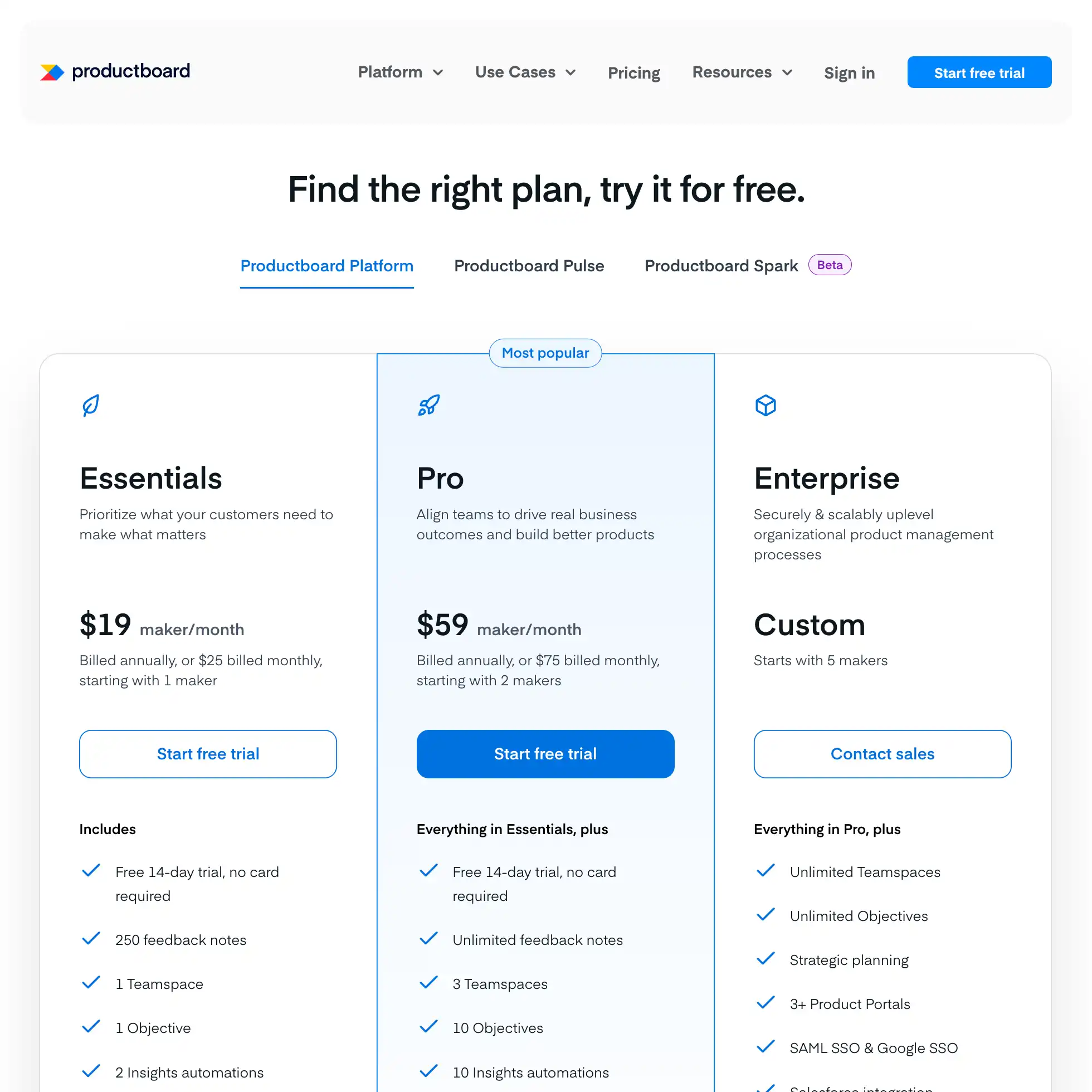
Productboard pricing plans
In mid-2026, Productboard updated its packaging to version v13, renaming its self-serve Starter, Essentials, and Pro tiers to Free, Plus, and Business, and bundling its Spark AI agent into every plan using monthly credit pools. Existing self-serve accounts on the older plan names move to the new structure at their first renewal on or after October 1, 2026, while contract accounts migrate at renewals on or after September 8, 2026. Every Maker in a workspace must be on the same plan tier.
| Plan | Monthly billing | Annual billing | Minimum Makers | Feedback notes | Spark AI credits | What it covers |
|---|---|---|---|---|---|---|
| Free | $0 | $0 | 1 | 500 lifetime | 50 per workspace/mo | 1 portal, 1 teamspace, 25 Contributors, roadmaps, 1 Jira and 1 Azure DevOps sync |
| Plus, or Essentials | $25 per Maker | $19 per Maker | 1 | 500 lifetime | 250 per Maker/mo | Adds manual and dynamic customer segments, Amplitude and Mixpanel usage integrations |
| Business, or Pro | $75 per Maker | $59 per Maker | 2 online, 5 contract | Unlimited | 500 per Maker/mo | Unlimited notes and teamspaces, 2 portals, custom statuses, dependencies, portal SSO and embedding |
| Enterprise | Not available | Custom quote | 5 | Unlimited | 800+ per Maker/mo | Unlimited Contributors, SAML SSO, SCIM, Salesforce, private teamspaces, white-label portal |
Free: $0 for up to 500 lifetime feedback notes
The Free plan gives a small team access to Productboard's core roadmapping views, prioritization formulas, one Product Portal, one teamspace, one Jira integration, one Azure DevOps integration, and up to 25 Contributors. It also includes access to the REST API, Productboard's MCP server, and 50 workspace Spark AI credits per month.
Where Free runs out of room is volume. The 500-note limit is a lifetime cap across your entire customer insights repository, not a monthly allowance that resets. You also cannot purchase extra Spark AI credit bundles on Free, and since a single customer feedback analysis in Spark typically consumes about 23 credits, the 50-credit monthly pool covers roughly two runs before AI pauses for the rest of the month.
Plus, formerly Essentials: $19 annual or $25 monthly per Maker
Plus costs $19 per Maker a month on annual billing, which comes to $228 per Maker a year, or $25 per Maker on monthly billing, with a one-Maker minimum. Moving from Free to Plus increases your Spark AI allowance to 250 pooled credits per Maker each month and unlocks manual and dynamic customer segments along with Amplitude and Mixpanel product-usage integrations.
What catches buyers off guard is that Plus keeps the exact same 500-note lifetime cap, single portal, single teamspace, and 25-Contributor ceiling as the Free plan. Note that before the July 2026 v13 update, legacy Essentials capped accounts at 250 notes. Plus also leaves out customizable feature statuses, dependency tracking, portal moderation, and iframe portal embedding. For any team actively piping Zendesk tickets, Intercom chats, or Slack messages into Productboard, 500 total notes will fill up within weeks, making Plus a short stopover on the way to Business.
Business, formerly Pro: $59 annual or $75 monthly per Maker
Business is the tier where Productboard unlocks unlimited feedback notes and unlimited teamspaces. It costs $59 per Maker a month on annual billing, or $708 per Maker a year, and $75 per Maker on monthly billing. Self-serve online checkout requires a minimum of two Makers, so the plan starts at $118 a month billed yearly or $150 a month billed monthly. If you buy Business through a sales contract rather than self-serve, the minimum jumps to five Makers, or $3,540 a year at list price.
Alongside unlimited notes, Business raises the Spark AI pool to 500 credits per Maker each month and adds a second Product Portal, portal moderation, custom voting questions and scales, iframe portal embedding, and HS256 JWT identity verification for the embedded portal. For internal planning, it unlocks customizable feature and entity statuses, feature dependency tracking, multiple release groups, board access controls, and up to five Jira and five Azure DevOps integrations. Like Free and Plus, Business still caps your workspace at 25 Contributors.
Enterprise: custom annual pricing for 5 or more Makers
Enterprise is sold only on annual contracts with a five-Maker minimum. It is the only plan that removes the 25-Contributor cap for new accounts, granting unlimited Contributors, unlimited notes, and unlimited Jira sync configurations.
Productboard gates its corporate security, governance, and branding controls to this tier. You need an Enterprise contract for SAML single sign-on with Okta, Entra ID, or OneLogin, Google SSO enforcement, SCIM user provisioning, IP allowlisting, audit logs, closed or private teamspaces, custom roles, and multiple workspaces. Enterprise is also required if you want the native Salesforce integration, on-premises Jira Server or Azure DevOps Server connectors, objective hierarchies, efficiency and allocation reports, or a white-labeled portal that removes the "Powered by Productboard" link from the footer.
Makers vs Contributors and Viewers
Every quote in Productboard revolves around how your teammates are classified across three internal roles:
- Makers are the paid seats at $19 to $75 a month. Anyone who creates or edits features, scores prioritization drivers, builds roadmaps, publishes portal cards, or manages workspace settings has to be a Maker.
- Contributors do not consume Maker seats, and plans below Enterprise include up to 25 of them. Contributors can submit internal feedback notes, highlight customer quotes, and collaborate inside Productboard documents, but they cannot prioritize features or edit roadmaps.
- Viewers are read-only internal users who can view shared timeline or column roadmaps and leave comments on features, without access to grid or insights boards. While legacy plans listed unlimited Contributors and Viewers and keep that allowance on migration, the current pricing page caps non-Enterprise plans at 25 Contributors and no longer publishes a separate numeric limit for Viewers.
In practice, that role split creates friction between product managers and engineering leads. If a tech lead or designer wants to move a card during sprint planning, update a feature's status, or adjust an effort estimate, a Viewer or Contributor login won't let them do it. Teams either pay $59 to $75 a month for every lead who touches the board, or restrict Maker seats to two or three PMs who end up doing all the status updates by hand.
Productboard Spark AI pricing and add-ons
Prior to mid-2026, Productboard sold Productboard AI as a $20 per Maker a month annual add-on on Pro and Enterprise, and briefly offered a standalone Spark Beta tier at $15 to $19 per Maker. Under the current v13 pricing, Spark is built into every plan and metered through pooled monthly credits.
Spark AI credits: included pools and $5 top-up bundles
Your monthly Spark credit pool depends on your plan and how many paid Makers you have:
- Free: 50 credits per month for the entire workspace.
- Plus: 250 credits per Maker per month, pooled across all Makers.
- Business: 500 credits per Maker per month, pooled across all Makers.
- Enterprise: Productboard's pricing card lists 800 credits per Maker per month, while its billing FAQ lists 1,500 base credits plus 800 per Maker. Ask sales which formula is written into your order form.
Productboard does not charge a flat fee per action. Instead, its billing FAQ publishes typical credit consumption and ranges based on task complexity: a customer feedback analysis typically uses 23 credits with a range of 5 to 77, drafting a product brief uses 25 credits, drafting a specification uses 29 credits with a range of 3 to 77, competitive research uses 33 credits, and roadmap planning uses 53 credits with a range of 21 to 79. Connecting a GitHub, GitLab, Bitbucket, or Azure DevOps cloud repository for read-only codebase indexing is free, while running a codebase analysis query typically uses 10 credits and can range up to 109 credits.
All included and purchased credits expire at the end of each monthly billing cycle with no rollover. If your team runs low, paid plans can buy top-up bundles in increments of 50 monthly credits for $5 a month, or 600 annual credits for $60 a year, delivered as 50 credits each month. Free workspaces cannot buy top-ups. Notice the pricing math on Plus: buying five 50-credit top-up bundles to get 250 extra credits costs $25 a month, whereas adding a second Plus Maker seat on annual billing costs $19 a month and adds 250 credits to your pool.
How Productboard handles an empty credit balance depends on how you bought your plan. On self-serve Free, Plus, and Business plans, admins receive warning emails at 80% and 100% usage, and once the pool hits zero, Spark stops accepting new AI tasks until next month while leaving your boards and notes open. On Business contract and Enterprise plans, Spark keeps running past 100% by default and automatically bills one-time overage bundles at the end of the month, unless an admin emails support in advance to put a hard cap on the account. In August 2026, Productboard's status page also logged an incident where repeated LLM calls burned through customer AI credits unintentionally; the company patched the bug and refunded the affected credits.
Legacy Productboard AI and Pulse retirement
Productboard AI and Productboard Pulse are no longer available for new customers to buy and are slated for retirement. When existing customers on older plans migrate to v13 pricing at renewal, separate bill lines for Productboard AI and Pulse are removed from their subscription. Most of their drafting and summary capabilities now live inside Spark, though Productboard's September 2026 documentation notes that legacy AI Topics and automatic insight-to-feature linking do not yet have direct equivalents in Spark and remain active for existing users until replacements ship.
Enterprise-only security, CRM, and unbranding gates
Unlike help desks that sell extra channels or security features as modular add-ons, Productboard locks its high-end capabilities inside the custom Enterprise tier. You cannot pay an extra monthly fee on Plus or Business to add SAML SSO, SCIM provisioning, Salesforce opportunity sync, or white-label portal branding. Even if you only have two product managers, needing SAML SSO or wanting to hide "Powered by Productboard" on your customer portal forces you onto a five-Maker annual Enterprise contract.
What Productboard actually costs at 2, 5, 10, and 20 Makers
To see what a growing product team pays in practice, the table below compares Plus and Business across four team sizes on both annual and monthly billing, assuming every person who edits the roadmap holds a Maker seat and the team stays within its included Spark AI credit pool.
| Team size | Plus annual | Plus monthly | Business annual | Business monthly |
|---|---|---|---|---|
| 2 Makers | $38/mo | $50/mo | $118/mo | $150/mo |
| 5 Makers | $95/mo | $125/mo | $295/mo | $375/mo |
| 10 Makers | $190/mo | $250/mo | $590/mo | $750/mo |
| 20 Makers | $380/mo | $500/mo | $1,180/mo | $1,500/mo |
While the Plus column looks affordable on paper, the 500-note lifetime ceiling means almost every active SaaS team ends up paying the Business rates in the right two columns. A five-person product team on Business pays $3,540 a year on annual billing or $4,500 a year month to month. A ten-person group of PMs, design leads, and engineering leads pays $7,080 a year on annual billing or $9,000 a year on monthly billing before buying any extra AI credit bundles.
Another cost cliff appears when your broader organization passes 25 Contributors. Because Free, Plus, and Business all cap Contributors at 25, a company where 35 support reps, customer success managers, and account executives want to push customer notes into Productboard or collaborate in specs has only two options: buy paid Maker seats for non-PMs at $59 to $75 a month each, or negotiate a custom Enterprise contract.
Compared to other roadmapping and feedback tools, Productboard Business at $59 per Maker billed yearly sits right beside Aha! Roadmaps Premium at $59 per user billed yearly, and costs more than twice as much per seat as Jira Product Discovery Premium at $25 per creator a month. Against tracked-user feedback boards, a ten-Maker Productboard Business plan at $590 a month billed yearly is roughly equivalent to Canny Pro at 1,000 tracked users, which runs $529 a month billed yearly or $661 monthly.
Contract terms, data exports, and renewal fine print
Before you sign an annual order form or move your backlog into Productboard, four billing and data policies in Productboard's Master Subscription Agreement and billing documentation are worth reading closely:
- 30-day written notice to prevent auto-renewal. Under Productboard's MSA, effective September 1, 2026, subscriptions automatically renew for the same contract length unless you provide written notice at least 30 days before your renewal date. While monthly self-serve plans can be canceled before the next monthly cycle, Productboard's billing help states that annual and multi-year plans require at least 30 days' notice and that late cancellation requests renew without exception.
- Removing a Maker does not lower your bill until renewal. If you add a Maker mid-cycle, Productboard charges a prorated fee right away. If someone leaves your team and you delete their account or downgrade their role, your paid seat count stays the same for the rest of the term. Seat reductions and plan downgrades only take effect at the next renewal, require at least 30 days' written notice on contracts, and carry no refunds for unused time.
- Renewal prices are not locked. Productboard's MSA allows the company to raise subscription prices at renewal with prior written notice, and states that any promotional discounts do not carry over into renewal terms.
- No whole-workspace export, and blank bodies on imported notes. If you cancel, you have 60 days to export your data before Productboard deletes the workspace within 60 to 90 days. However, Productboard's official export guide states that there is no single whole-workspace backup export; you have to export features, feedback notes, and customers as separate CSV files. Even more important, when you export your feedback notes to CSV, any notes that originally came in through Zendesk, Slack, or Intercom integrations export with a blank message body.
Is Productboard worth it?
Productboard is worth the price when you have a dedicated product management department running a multi-product portfolio and your workflow centers on internal evidence gathering rather than a public community board. If your PMs spend their week pulling call transcripts from Gong and tickets from Zendesk, highlighting customer quotes to build a weighted Customer Importance Score, modeling RICE or WSJF formulas tied to company OKRs, and presenting timeline roadmaps with two-way Jira or Azure DevOps sync to executives, Productboard is purpose-built for that job.
For most startups and B2B SaaS teams, that heavy internal machinery creates two problems. First, someone has to maintain it. Keeping a four-level hierarchy of products, components, features, and subfeatures clean while triaging incoming notes takes constant administration; as one Reddit user noted in August 2025, the platform "requires full time attention," and a December 2025 G2 reviewer pointed to "a lot of complexity" in daily setup. On July 17, 2026, Productboard also deprecated its daily overview emails and weekly insights digest, removing two of the passive summaries teams relied on to keep up with workspace changes.
Second, Productboard leaves a gap on the customer-facing side of your product. Because portal submissions are private to the sender, your users cannot browse existing feature requests, rally around an idea, or discuss edge cases in a thread. There is no standalone changelog product, so release notes have to live as a tab on your portal, and Spark is an internal PM assistant that cannot answer customer support questions in live chat. You end up paying $59 to $75 per Maker for internal planning while still needing a separate tool for public feedback, product updates, and customer support.
Productboard alternatives
UserJot


We built UserJot for software teams that want their customers voting in public and their whole team collaborating on the roadmap without counting seats or AI credits. UserJot puts your public and private feedback boards, product roadmap, changelog, in-app widget, and live chat and support inbox into one fast workspace for a flat $0, $29, or $59 a month.
Instead of locking customer ideas in a private silo, UserJot gives your users a community board where they can search existing requests, upvote, and comment, either at your board's URL or inside your app through the widget. As someone types a new post, embedding search surfaces matching requests in real time so they can open an existing thread instead of creating a duplicate, and customers can capture and annotate screenshots with arrows, boxes, text, and redaction right from the widget composer. When you mark a request Planned or In Progress, it moves onto your public three-column roadmap automatically. When you mark it Completed, everyone who posted, voted, or commented gets an email automatically, and Juno, our AI assistant, can draft your changelog post from those completed requests inside the editor for you to review and publish.
If you turn on Conversations, currently in beta and free on every plan while in beta, the same widget adds live chat and your team gets a shared inbox for chat and forwarded support email. Juno answers routine customer questions from your help docs and crawled websites, hands the thread to your team when a person is needed, and searches your public feedback board right inside the chat so she can file a new request or add the customer's vote once they confirm.
| Team size | Productboard Business annual | Productboard Business monthly | UserJot |
|---|---|---|---|
| Free tier | 500 lifetime notes, 1 portal | 500 lifetime notes, 1 portal | $0, unlimited |
| 2 Makers / teammates | $118/mo | $150/mo | $0 or $29/mo |
| 5 Makers / teammates | $295/mo | $375/mo | $29/mo |
| 10 Makers / teammates | $590/mo | $750/mo | $29 or $59/mo |
UserJot's Free plan never expires and includes unlimited end users and posts, two feedback boards, three team seats for owners and admins, the public roadmap, the changelog, and the in-app widget. Starter at $29 a month covers up to 100 team seats with no per-seat charge and five boards, and adds a custom domain like feedback.yourcompany.com, guest posting and voting without an account, private boards where a signed-in customer sees only their own requests while your team sees all of them, post moderation, and automatic login from your app onto the board. Our REST API and MCP server for Claude Code, Cursor, Codex, and other remote MCP clients are on every plan, including Free, so an agent or integration works from day one without paying. Professional at $59 a month scales to 100 feedback boards and adds single sign-on where your server signs a JWT, public identity masking, and the option to remove the "Powered by UserJot" badge. You can import your exported Productboard CSV with AI column mapping, and export your UserJot posts as a CSV any time on every plan.
We also keep a clear boundary around what UserJot does not try to be: we don't build four-level OKR hierarchies, weighted RICE spreadsheets, Gantt dependency charts, or native Jira and Salesforce sync, and we focus on Slack, Discord, email-to-feedback, our REST API, and MCP instead. If you need an internal portfolio planning suite with two-way Jira sync, stick with Productboard. If you want a public feedback board, roadmap, changelog, and support inbox at one flat workspace price, see our full Productboard alternative comparison.
Other feedback and roadmap tools to compare
If you are weighing other tools alongside Productboard, here is how the main alternatives structure their pricing and limits:
Canny starts with a Free plan capped at 25 tracked users and jumps to $79 a month billed yearly, or $99 monthly, on Pro for 100 tracked users, climbing to $529 a month billed yearly, or $661 monthly, once 1,000 customers vote or comment on your board. Unlike Productboard, Canny gives you an open community voting board and a standalone changelog, and connects to Jira, Linear, and GitHub starting on Pro. See Canny vs Productboard and Canny pricing.
Aha! Ideas charges $39 per user a month on annual billing, or $49 monthly, with a three-seat minimum and no free plan, and requires a paid seat for every internal teammate who even views ideas. Teams that want full roadmapping, prioritization scoring, and Jira sync use Aha! Roadmaps starting at $59 per user a month billed yearly, or $74 monthly. See Aha! pricing and Aha! Ideas alternatives.
Jira Product Discovery is Atlassian's internal idea scoring and roadmapping tool for teams whose engineering workflow already lives in Jira. It offers a free tier for up to three creators, $10 per creator a month on Standard for shareable read-only roadmaps, and $25 per creator a month on Premium for cross-project timelines and dependencies, with free internal contributors, though it has no public community voting portal or changelog. See Jira Product Discovery pricing.
Nolt skips per-seat and per-voter billing and charges $29 a month billed yearly, or $39 monthly, for a single feedback board, roadmap, and changelog with Jira, Linear, and GitHub sync, or $69 a month billed yearly for up to five boards. There is no free plan after its 10-day trial. See Nolt alternatives.
Fider is an open-source feedback board that is free if you self-host it with Docker and Postgres on your own servers, or $25 a month per board on Fider's hosted Pro plan once you pass its 250-post hosted free tier. It handles public feature request posting and voting, without a standalone changelog, in-app widget, or AI features. See Fider alternatives.
You can compare all of these side by side in our guide to the best customer feedback tools.
Frequently asked questions
How much does Productboard actually cost?
Productboard Plus, formerly Essentials, costs $19 per Maker a month billed yearly or $25 a month billed monthly, but caps your workspace at 500 feedback notes total. Most active teams need Business, formerly Pro, for unlimited feedback notes, which costs $59 per Maker a month billed yearly or $75 a month billed monthly with a two-Maker minimum, bringing a ten-Maker team to $590 a month on annual billing or $750 monthly.
Does Productboard have a free plan?
Yes, Productboard offers a permanent Free plan alongside a 14-day free trial of its Business tier with no credit card required. The Free plan includes one portal, one teamspace, 25 Contributors, 50 monthly Spark AI credits, and a lifetime limit of 500 feedback notes across the workspace.
What is the difference between a Maker, a Contributor, and a Viewer in Productboard?
A Maker is a paid seat ranging from $19 to $75 a month for anyone who creates features, scores priorities, edits roadmaps, or manages the portal. Contributors are free, capped at 25 on Free, Plus, and Business, and can submit internal feedback notes and collaborate in documents without editing roadmaps. Viewers have read-only access to shared roadmaps and portals and can leave comments on features, but cannot edit statuses or move roadmap items.
How do Productboard Spark AI credits work?
Productboard bundles Spark into every plan with monthly credit pools that expire at the end of each billing cycle: 50 workspace credits on Free, 250 per Maker on Plus, and 500 per Maker on Business. A single customer feedback analysis typically uses about 23 credits and drafting a specification uses about 29 credits, and paid plans can buy extra 50-credit top-up bundles for $5 a month. On self-serve plans Spark pauses when credits run out, whereas contract and Enterprise plans automatically bill overages unless you email support for a hard cap.
Can customers see and vote on each other's requests in Productboard?
No. When a customer submits feedback on a Productboard portal, that note is private to the sender and your internal team. Other visitors can only vote on feature cards that a Maker has manually published to the portal, and cannot browse or comment on raw ideas submitted by other users.
What happens if I remove a Maker seat or cancel Productboard?
Deleting a team member or downgrading a Maker to a Contributor or Viewer mid-contract does not reduce your bill; seat reductions only take effect at your next renewal with no refund for unused time. Annual and multi-year contracts require written non-renewal notice at least 30 days before your renewal date, and after cancellation you have 60 days to export your feature and feedback CSVs before the data is deleted.
How does UserJot compare to Productboard on price?
Productboard charges per Maker seat, so a ten-person team on Business pays $590 a month billed yearly or $750 a month billed monthly. UserJot charges a flat workspace rate of $0 on Free for up to three admins, $29 a month on Starter for up to 100 admins, or $59 a month on Professional for up to 100 admins, with unlimited end users and posts on every plan.
Unlimited users, flat pricing, and simple setup.
UserJot keeps feedback, roadmap, and changelog in one simple loop.