Canny vs ProductBoard 2026: Which Product Feedback Tool Should You Choose?
Shayan, Founder11 min read

Canny and ProductBoard are two of the most popular tools for product teams, but they solve fundamentally different problems. Canny excels at collecting and organizing customer feedback from end-users, while ProductBoard is built for complex product management across large organizations.
The choice between them depends on whether you need a customer-facing feedback board or an internal product management platform. But there's a third option worth considering if you want the best of both worlds without the enterprise price tag.
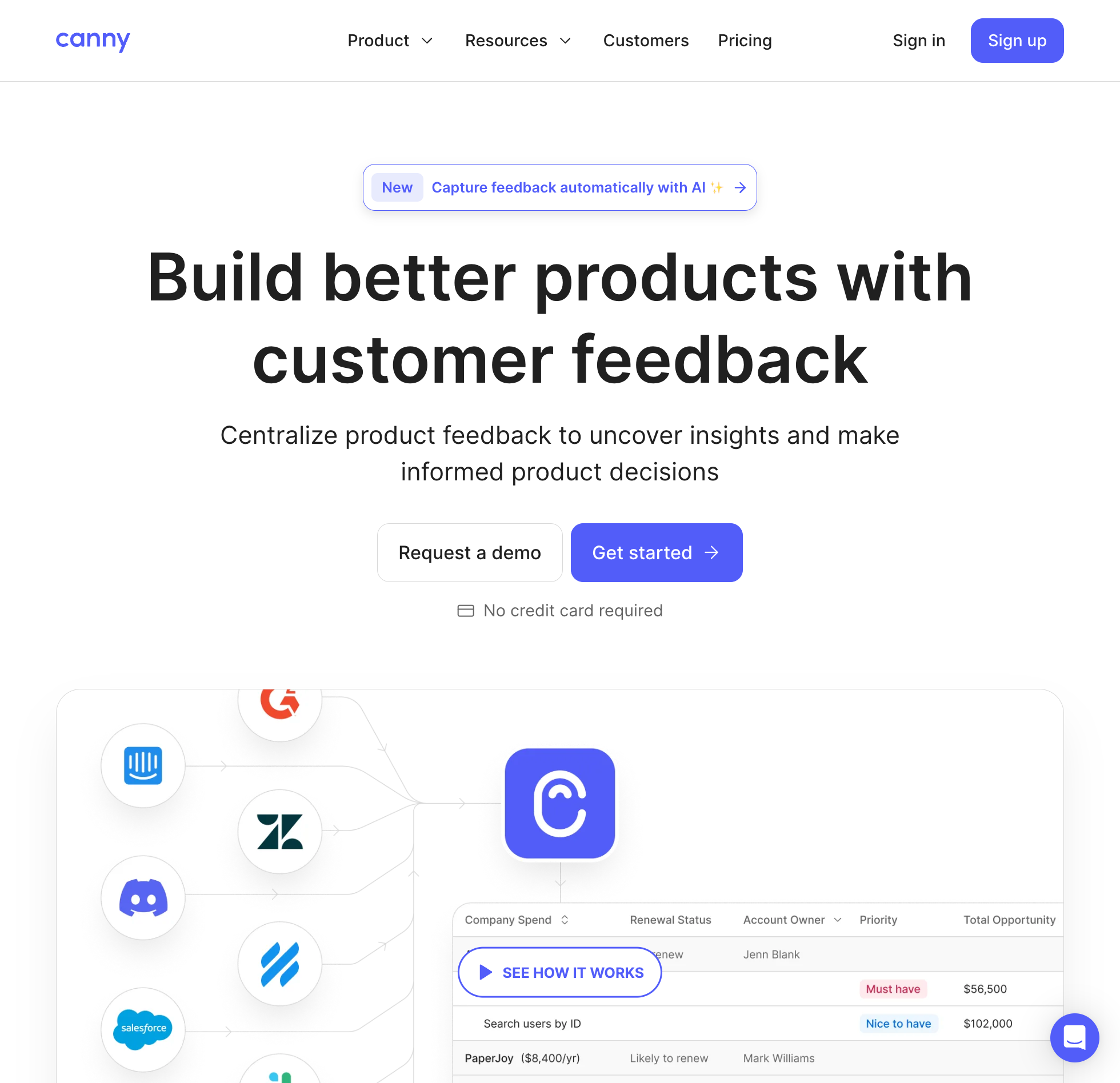
What is Canny?
Canny is a customer feedback management platform designed to help product teams collect, organize, and prioritize feature requests. It's known for its clean, user-friendly interface and straightforward feedback workflow.
The core use case is simple: customers submit feedback, vote on existing ideas, and product teams use that data to decide what to build next. Canny also includes basic roadmapping and changelog features to close the feedback loop.
Best for: Teams that want a public-facing feedback board where customers can directly submit and vote on feature requests.
What is ProductBoard?
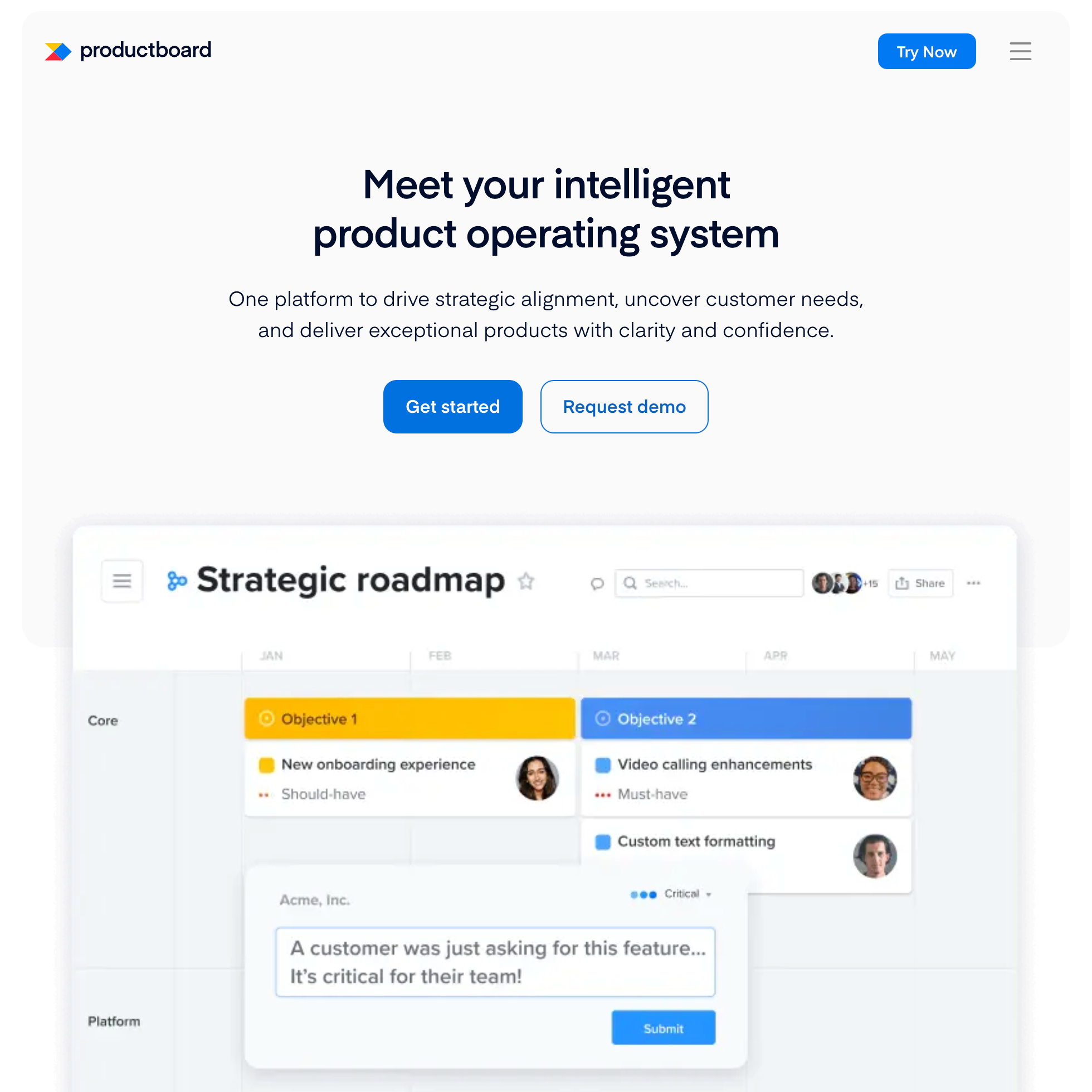
ProductBoard is an enterprise product management platform built for large organizations managing multiple products and complex workflows. It's designed to centralize feedback from various sources (support tickets, sales calls, interviews) and connect them to strategic product initiatives.
ProductBoard's strength lies in its ability to create alignment across product teams, leadership, and everyone involved in product decisions. It offers advanced prioritization frameworks, strategic planning tools, and extensive customization options.
Best for: Enterprise organizations with multiple product managers, complex product portfolios, and dedicated product operations teams.
Pricing Comparison: The Real Costs
The pricing models couldn't be more different. Canny charges based on customer engagement, while ProductBoard charges per team member.
Canny Pricing
Canny switched to a "tracked users" model in May 2025. Every person who interacts with your feedback (posting, voting, or commenting) counts as a tracked user. Your costs scale directly with customer engagement.
| Tracked Users | Core Plan | Pro Plan |
|---|---|---|
| 100 | $24/mo | $99/mo |
| 500 | $156/mo | $349/mo |
| 1,000 | $311/mo | $661/mo |
| 2,500 | $499/mo | $1,036/mo |
Key insight: If you have 1,000 active customers engaging with your roadmap, you're paying $311-661/month. As your product grows and more customers participate, your costs increase.
ProductBoard Pricing
ProductBoard charges per "Maker," which is anyone who needs full access to prioritize features or manage feedback. Viewers are free but have minimal permissions.
| Team Size (Makers) | Essentials | Pro | Enterprise |
|---|---|---|---|
| 2 Makers | $38/mo | $118/mo | Custom |
| 5 Makers | $95/mo | $295/mo | Custom |
| 10 Makers | $190/mo | $590/mo | Custom |
| 20 Makers | $380/mo | $1,180/mo | Custom |
Prices shown are billed annually. Monthly billing adds 20-25%.
Key insight: A team of 10 product managers on the Pro plan costs $590/month regardless of how many customers engage with your feedback. However, most teams need Pro at minimum for essential features like unlimited feedback notes and customer segmentation.
Starting prices before scaling (Canny at 100 users, ProductBoard per maker)
Which Pricing Model is Better?
Canny's model penalizes customer engagement. Every successful feature request that gets shared and voted on increases your bill. It's a growth tax on building community around your product.
ProductBoard's model penalizes team collaboration. Want your engineering lead to help prioritize features? That's another $75/month per person. It creates a "collaboration tax" where teams restrict access to save money.
Both models have structural problems. Canny charges you more as customers engage, and ProductBoard charges you more as your team collaborates.
Feature Comparison
Feedback Collection
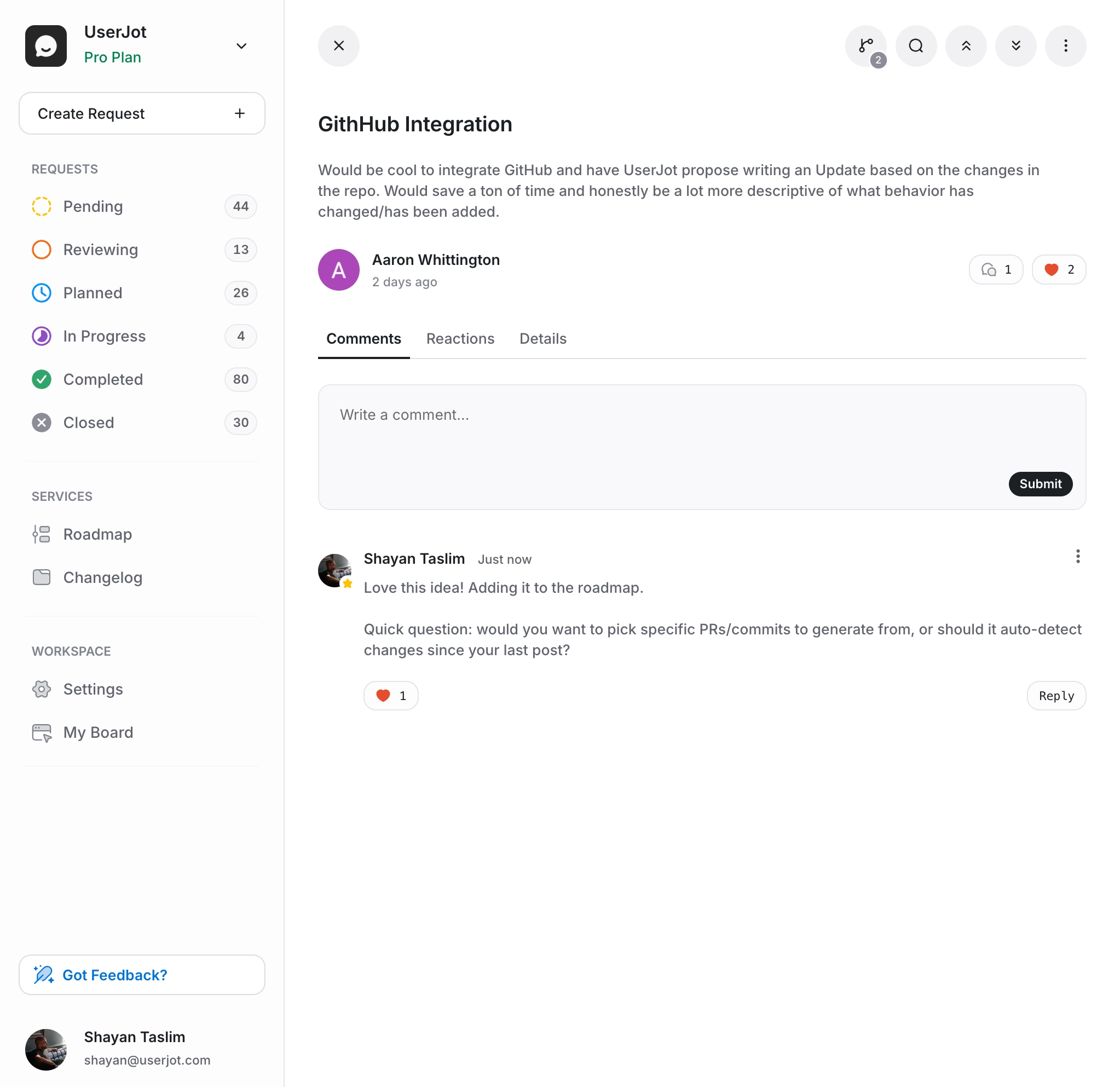
Canny wins here. Its entire design is optimized for customer-facing feedback:
- Public feedback boards with voting
- Automatic duplicate detection as users type
- Clean, intuitive submission forms
- Comment threads on each request
- Status updates visible to customers
- Email notifications to voters when features ship
Customers feel heard because they can see their feedback in context, vote on others' ideas, and track progress publicly.
ProductBoard struggles with collection. While it can centralize feedback from various sources (Intercom, Zendesk, sales notes), it's not designed for direct customer submission. Setting up a public portal feels like an afterthought rather than a core feature.
Feedback Analysis
ProductBoard dominates here. Its analysis capabilities are built for product teams that need to:
- Connect feedback to specific customer segments
- Link feedback to MRR impact
- Create custom prioritization frameworks
- Identify patterns across thousands of notes
- Segment insights by customer type or feature area
You can ask questions like "What features do customers spending $10K+/year want most?" and get data-driven answers.
Canny's analysis is basic. You can see vote counts, filter by tags, and sort by various criteria. But there's no customer segmentation, no MRR impact analysis, and limited ability to connect feedback to business outcomes. It's designed for transparency with customers, not deep analysis for internal strategy.
Roadmapping
ProductBoard is purpose-built for roadmapping. It offers:
- Multiple roadmap views (timeline, kanban, list)
- Hierarchical structure (objectives → initiatives → features)
- Customizable roadmaps for different audiences
- Dependency tracking across initiatives
- Integration with delivery tools (Jira, Linear, Azure DevOps)
You can create strategic roadmaps that connect to company objectives and tactical roadmaps that sync with engineering workflows.
Canny's roadmapping is lightweight. You get one public roadmap that shows what's "Planned," "In Progress," and "Complete." It's perfect for customer transparency but lacks the depth needed for internal planning. No dependencies, no hierarchies, no strategic alignment.
Changelog & Updates
Both tools offer changelog features, but with different focuses:
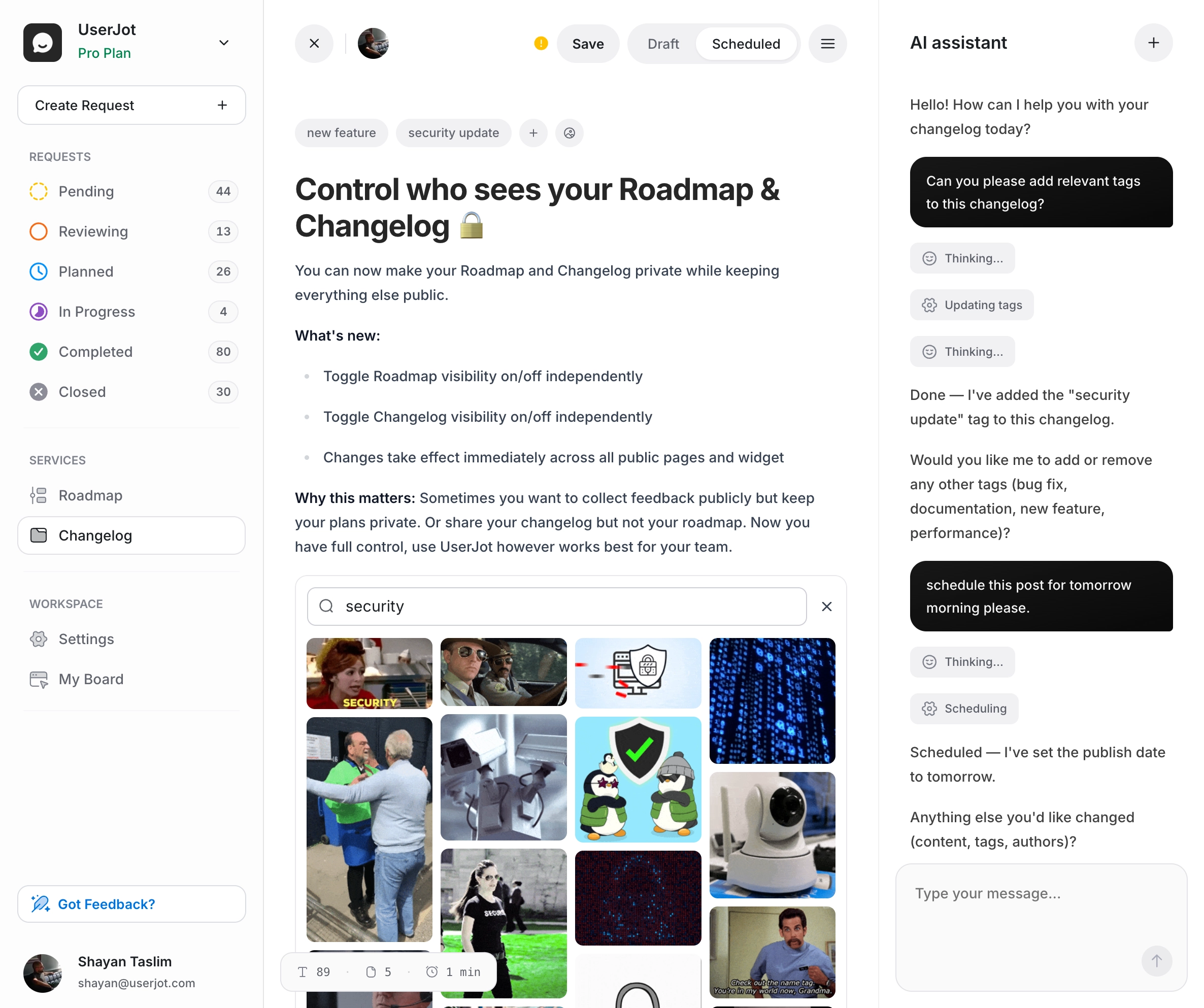
Canny's changelog is designed for customer engagement. When you ship a feature, everyone who voted on it gets an email. The changelog is public by default and encourages users to discover new features.
ProductBoard's changelog (called "Releases") is more about coordinating launches across teams. You can notify specific customer segments, create release themes, and track which features shipped in each release.
Integration Ecosystem
Canny Integrations
Canny offers solid integrations for feedback collection:
- Support tools: Intercom, Zendesk, Help Scout
- Communication: Slack, Discord, Microsoft Teams
- Project management: Jira, ClickUp, Asana, Linear, GitHub
- CRM: HubSpot, Salesforce
- Auth: SSO (Business plan only)
The focus is on capturing feedback from wherever customers communicate and syncing status updates to project management tools.
ProductBoard Integrations
ProductBoard goes deeper with enterprise integrations:
- Project management: Jira (two-way sync), Azure DevOps, GitHub
- CRM: Salesforce (advanced), HubSpot
- Analytics: Amplitude, Mixpanel, Pendo
- Support: Zendesk, Intercom, Gong
- Design: Figma, Miro
- Auth: Okta, Entra ID, OneLogin (Enterprise only)
ProductBoard's integrations are designed to pull data from across your stack into one place.
AI Features
Both platforms have jumped into AI, but with different approaches:
Canny Autopilot (Included in all plans)
- Feedback Discovery: Automatically captures feedback from conversations in Intercom, Zendesk, and other sources
- Smart Replies: AI-generated follow-up questions to gather more context
- Comment Summaries: Instantly recap long feedback threads
- Duplicate Detection: AI identifies similar feedback as users type
The focus is on reducing manual work for product teams managing feedback at scale.
ProductBoard Spark ($15/maker/month, currently in beta)
- Product Brief Generation: AI creates PRDs and product specs based on your product context
- Feedback Analysis: Ask questions about feedback trends and get instant insights
- Competitive Research: Automated competitor analysis and positioning
- Shared Knowledge: Builds institutional knowledge that survives team changes
ProductBoard's AI is positioned as a "product agent" that understands your strategy and helps with higher-level PM workflows.
Key difference: Canny's AI helps manage incoming feedback. ProductBoard's AI helps with strategic product decisions.
User Experience
Canny's UX
Canny feels like a consumer product. It's fast, clean, and minimal. New users understand it immediately. The interface is optimized for the 90% use case: seeing feedback, checking votes, and updating status.
The learning curve is measured in minutes. You can set up a feedback board and start collecting input in under 10 minutes.
ProductBoard's UX
ProductBoard feels like enterprise software. It's powerful but complex. The interface is designed for product teams that live in the tool daily, with features layered on features.
The learning curve is measured in weeks. Most teams need formal training, careful taxonomy setup, and time to configure prioritization frameworks. This depth is intentional. It's built for teams managing complex product portfolios.
Users often describe ProductBoard as "heavy" compared to newer tools. If your team is used to fast, keyboard-driven interfaces, ProductBoard might feel sluggish.
When to Choose Canny
Choose Canny if you:
- Want a public-facing feedback board where customers directly submit ideas
- Need to build community around your product roadmap
- Prioritize customer transparency over internal strategy tools
- Have a small product team (1-3 PMs) managing a single product
- Value simplicity and want something that works out of the box
- Want customers to feel like they're part of the product development process
Ideal user: A B2B SaaS startup with 100-1,000 customers who want to make product decisions feel transparent and community-driven.
When to Choose ProductBoard
Choose ProductBoard if you:
- Manage multiple products or complex product portfolios
- Have 10+ product managers who need to align on strategy
- Need advanced prioritization based on custom scoring frameworks
- Want to connect feedback to business goals and company-wide initiatives
- Have a dedicated product operations team to manage the tool
- Need deep CRM integration to tie feedback to revenue data
- Can afford enterprise-level pricing and implementation time
Ideal user: A company with 50+ employees, multiple products, and product management as a distinct discipline with dedicated resources.
What Both Tools Get Wrong
Canny's Growth Tax
The tracked user model fundamentally conflicts with building a vibrant product community. The more successful your feedback board becomes, the more you pay. One viral feature request can push you into a higher pricing tier overnight.
This creates perverse incentives. Do you really want to limit customer engagement to control costs? That defeats the purpose of collecting feedback.
ProductBoard's Collaboration Tax
The per-Maker pricing model assumes product management is a small, specialized function. But modern product development requires input from engineering, design, sales, and customer success.
When you charge $75/month per active participant, teams restrict access. This creates information silos and slows down decision-making, which is the opposite of what product tools should do.
A Third Option Worth Considering
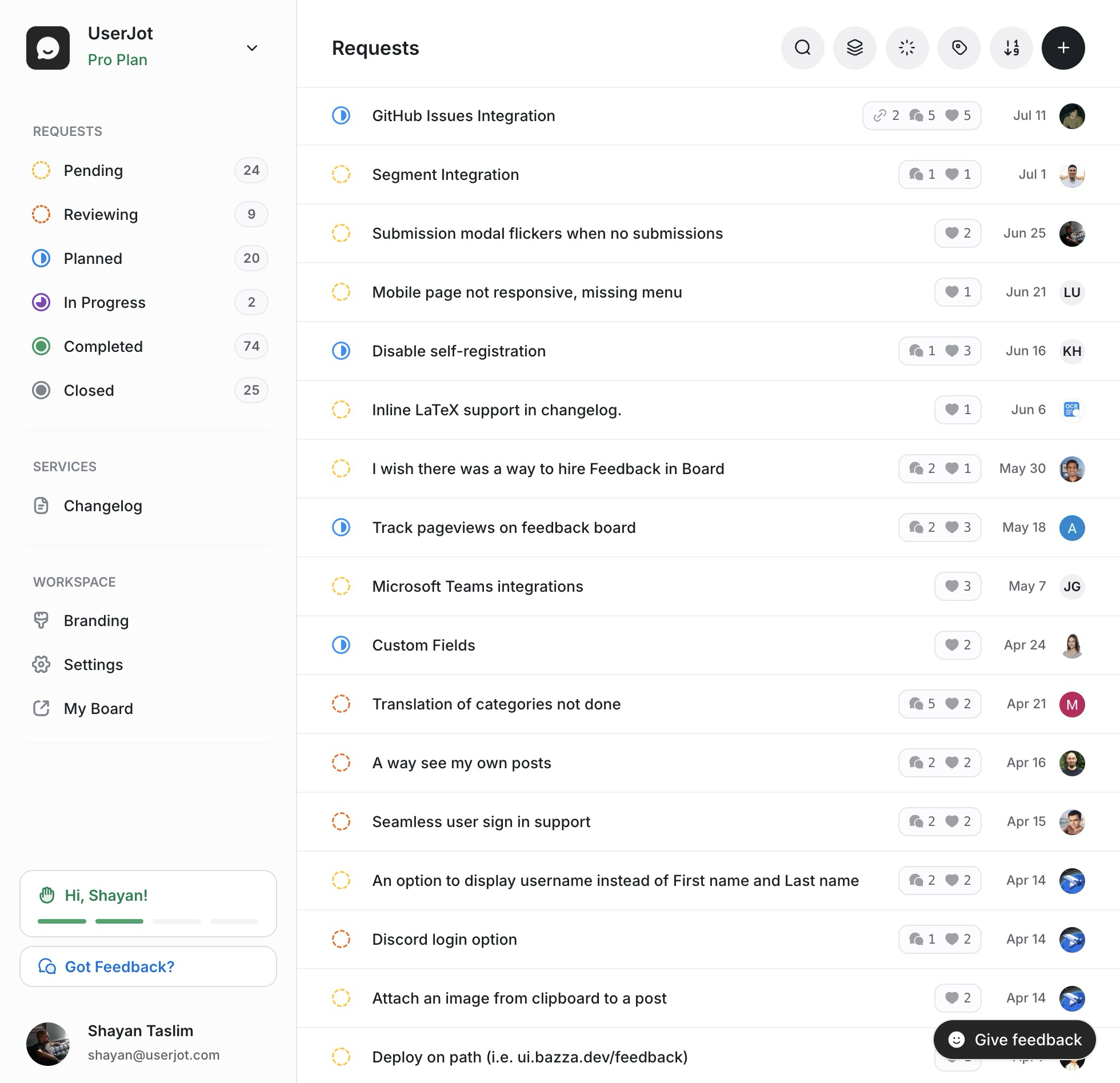
We built UserJot because we saw the same problems with both approaches. Why should you pay more when customers engage? Why should collaboration cost extra?
How We Think About Pricing
We charge for features, not people or engagement:
| Plan | Price | What You Get |
|---|---|---|
| Free | $0 | Unlimited users, 2 boards, roadmap, changelog |
| Starter | $29 | Unlimited users, 5 boards, custom domain, 1 integration |
| Professional | $59 | Unlimited users, unlimited boards, SSO, all integrations |
There are no per-user fees, no tracked user limits, and no collaboration tax. You just pay for the features you need.
How We Compare
vs Canny:
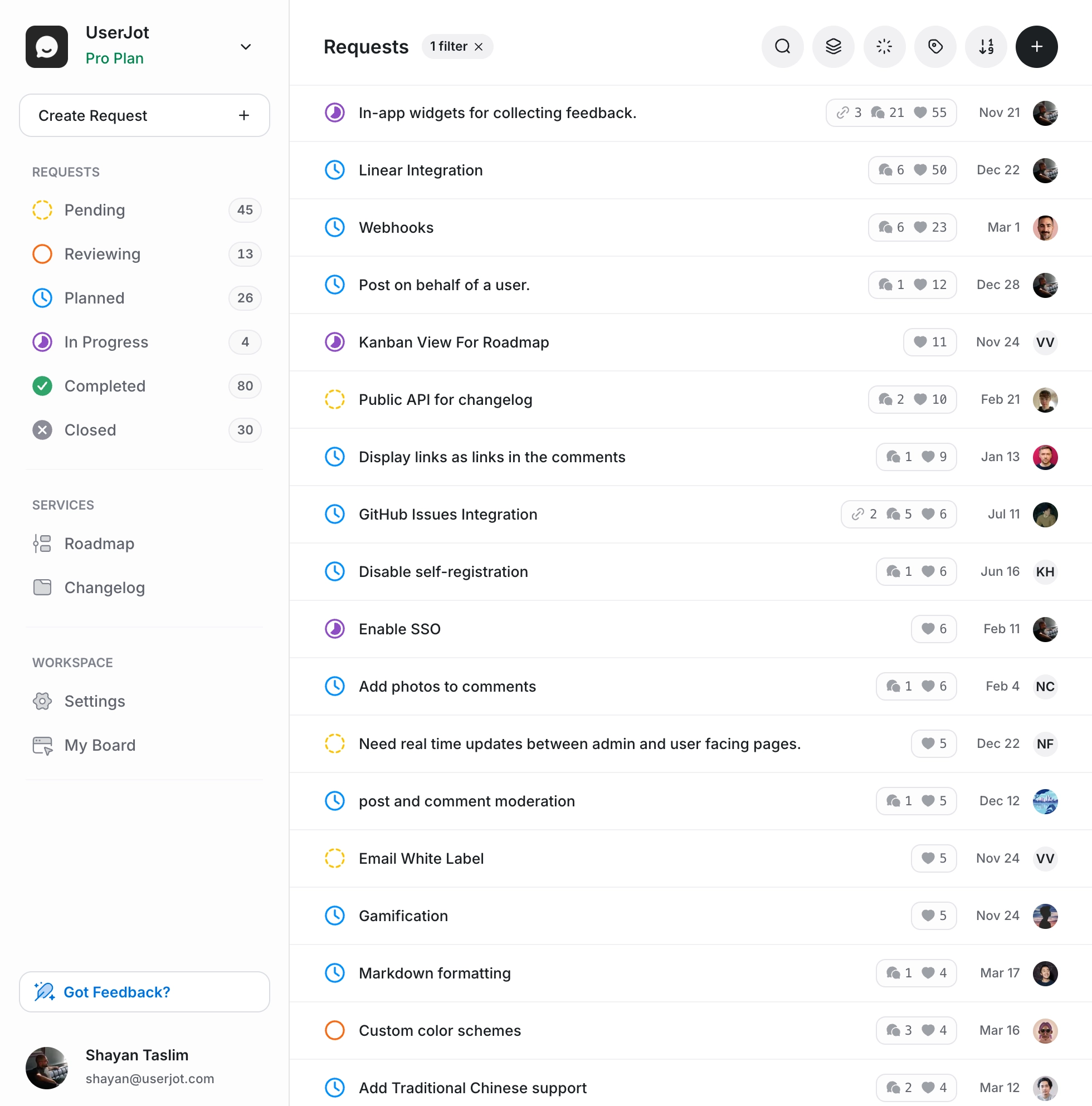
- Same clean, customer-facing feedback boards
- Same public voting and commenting
- But unlimited customer engagement at flat prices
- Save 70-90% compared to Canny at scale
vs ProductBoard:
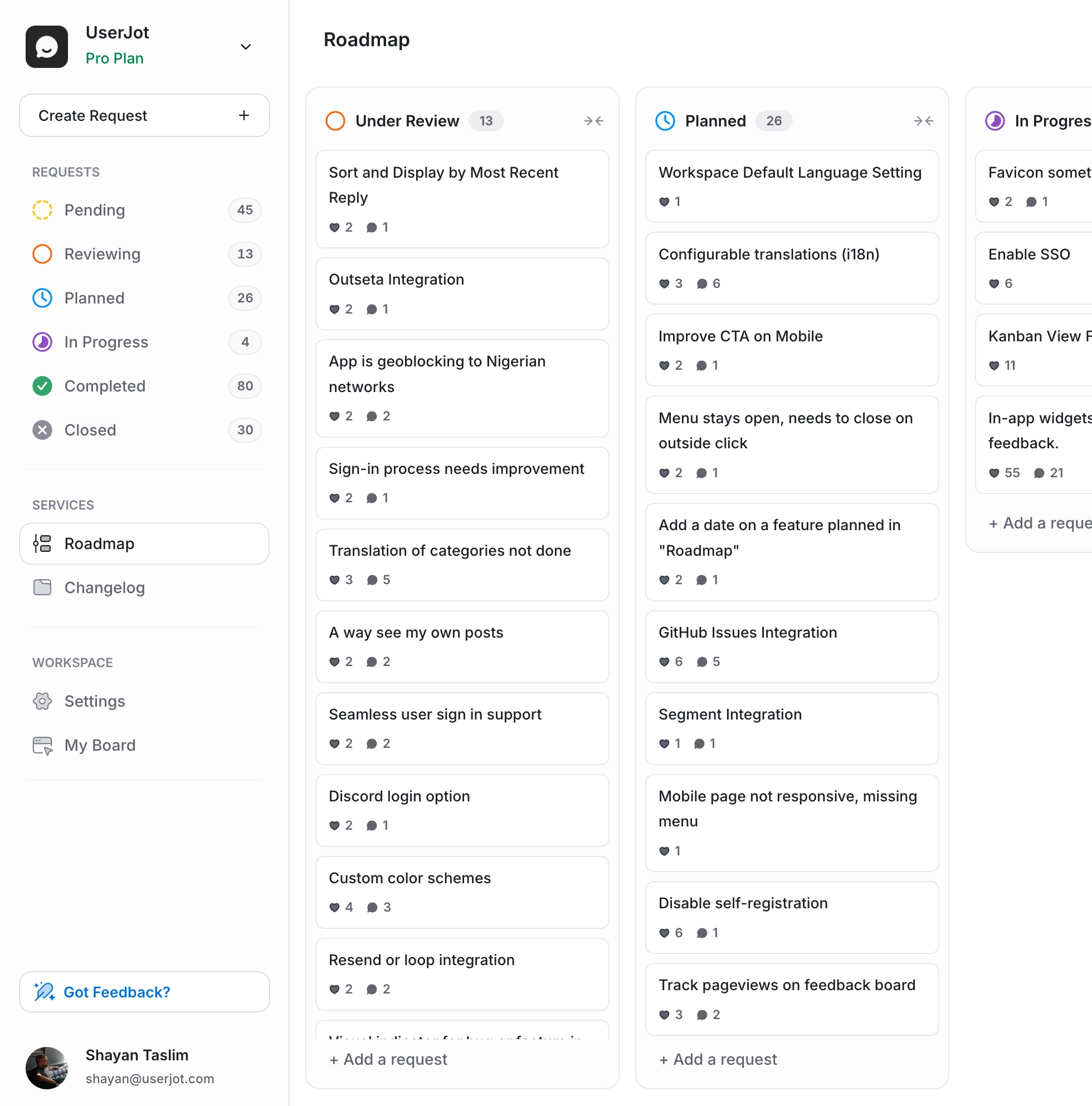
- Advanced features like AI duplicate detection and automatic tagging
- Fast, modern interface built for speed
- Unlimited admin seats for your whole team
- $29-59/month total vs $590+/month for 10 people on ProductBoard Pro
Migration Made Easy
Switching from either tool takes under 15 minutes:
- Export your data from Canny or ProductBoard
- Import with one click using our migration tool
- Feedback, votes, and participating users transfer automatically
- Review the imported data, then point users to the new board
We've helped teams move from both Canny and ProductBoard, and the whole process usually takes under 15 minutes.
Unlimited users, predictable costs. See how flat pricing compares.
UserJot keeps feedback, roadmap, and changelog in one simple loop.
Frequently Asked Questions
Which is more expensive: Canny or ProductBoard?
It depends on your usage. For a team with 1,000 active customers engaging with feedback, Canny costs $311-661/month. For a team with 10 product managers, ProductBoard Pro costs $590/month. Canny scales with customer engagement, ProductBoard scales with team size.
Can I use both Canny and ProductBoard together?
Some teams do this, using Canny for public feedback collection and ProductBoard for internal strategy. However, this creates data silos and doubles your tool costs. Most teams find this unsustainable long-term.
Does Canny have the features ProductBoard has?
No. Canny is focused on customer feedback management with basic roadmapping. It lacks ProductBoard's strategic planning, advanced prioritization frameworks, and deep analytics. However, many teams don't need that complexity.
Is ProductBoard overkill for small teams?
Usually yes. If you have fewer than 5 product managers and manage a single product, ProductBoard's complexity and cost are hard to justify. The tool is built for scale you probably don't need yet.
What happened to Canny's free plan?
Canny retired legacy free plans in December 2025. Teams on old plans had to upgrade to the new tracked user pricing or lose admin access. This pushed many teams to re-evaluate their options, and some moved to alternatives with more generous free tiers.
Which tool has better AI features?
ProductBoard's Spark AI is more advanced, offering strategic product briefs and competitive analysis. Canny's Autopilot focuses on feedback management automation. However, ProductBoard charges $15/maker/month extra for AI, while Canny includes it free.
Can ProductBoard replace Canny for customer-facing feedback?
Technically yes, through its portal feature. But it's not designed for it and feels clunky compared to purpose-built tools. Most teams using ProductBoard for public feedback report it's awkward for customers to use.
Does UserJot work for enterprise teams?
Yes. We have enterprise customers who switched from ProductBoard specifically for our unlimited team seats and simple pricing. Our Professional plan ($59/month total) includes SSO, which would require an expensive Enterprise contract with competitors.
How do I decide between these tools?
Ask yourself: Are you optimizing for customer engagement or internal strategy?
If you want customers to feel like partners in building your product, choose a customer-facing tool (Canny or UserJot).
If you're managing complex product portfolios across multiple teams and need deep strategic planning, choose ProductBoard.
If you want both customer transparency and modern product management without enterprise pricing, check out UserJot. We compare it with each tool in our Canny alternative and Productboard alternative guides.
Making the Right Choice
Canny and ProductBoard solve different problems for different teams at different scales. Neither is objectively "better." They're optimized for different use cases.
Choose Canny if customer-facing feedback and transparency are your top priorities, and you have a small team with a single product.
Choose ProductBoard if you're an enterprise with complex product portfolios, multiple PMs, and need sophisticated strategic planning tools.
Consider UserJot if you want modern feedback management, customer transparency, and unlimited collaboration without paying a growth tax or collaboration tax.
The product feedback tool market has evolved beyond just these two options. Modern teams are finding that flat pricing, unlimited users, and purpose-built features offer better value than legacy pricing models designed for a different era.
If you want to see how it compares firsthand, UserJot has a free plan. No credit card needed.