How to Assess Feature Requests: Frameworks That Actually Work
Shayan, FounderUpdated 8 min read

If you've ever stared at a backlog full of feature requests wondering where to even start, you're not alone. The textbook answer involves "systems review committees" and "structured evaluation criteria," which isn't particularly helpful when you have 47 requests to sort through on a Monday morning.
Here's what actually works.
Start By Understanding the Real Problem
Feature requests are rarely what they seem on the surface. Someone asking for "tags" might actually need better search. A request for "integrations" is often just someone who's tired of copying data between tools manually. Before you score anything or put it through a framework, spend a few minutes understanding what's really going on.
Ask the person what problem they're trying to solve. Look at how they're working around the issue today, because workarounds tell you how much something actually hurts. And check whether anyone else has the same problem. One person complaining is a note. Twenty people with the same issue is a pattern worth paying attention to.
Once you understand the underlying problem, you can evaluate whether it's worth solving, whether the requested solution is even the right one, and how it compares to everything else on your list.
RICE Scoring
RICE was built by Intercom and it's probably the most widely used prioritization framework. You multiply four factors together: Reach, Impact, Confidence, and Effort (which goes in the denominator).
Reach is how many users this affects in a given time period. Use real numbers when you can. "500 users per quarter" beats "a lot of people."
Impact is how much it improves things per user. Intercom scores this 3 for massive, 2 for high, 1 for medium, 0.5 for low. Keep it simple.
Confidence is how sure you are about your estimates. Be honest. 100% means you've validated it. 50% means you're mostly guessing.
Effort is how long it takes to build, usually in person-months.
A quick example: say you're evaluating a bulk export feature. 200 users request it monthly, impact is high (2), you're 80% confident, and it takes one person-month. Score: (200 × 2 × 0.8) / 1 = 320. Compare that to other requests and priorities start to emerge.
RICE works well when you have real data. It's less useful early on when everything is a guess, but even then it keeps you honest about your assumptions.
ICE Scoring
ICE is RICE's simpler cousin. It drops Reach entirely and just uses Impact, Confidence, and Ease, each scored 1 to 10 and multiplied together.
Growth teams love it because it's fast. You can score a list of ideas in a few minutes without needing detailed user metrics. The tradeoff is that without the reach component, you might prioritize things that only matter to a handful of users.
If you don't have detailed metrics yet, ICE gets you moving without pretending you have precision you don't actually have.
MoSCoW Method
MoSCoW doesn't give you scores. It sorts requests into four buckets: Must-have (non-negotiable), Should-have (important but shippable without), Could-have (nice if there's time), and Won't-have (not now).
The power here is alignment. Everyone understands the difference between "must" and "should" and "could." No spreadsheets required. For release planning, asking "what must ship in v2?" is a much easier conversation than "what's the RICE score of everything?"
The downside: it doesn't help you prioritize within categories. Ten things in "should-have" still need to be ranked somehow.
Stop guessing what to build. Let your users vote.
UserJot keeps feedback, roadmap, and changelog in one simple loop.
The Value vs Effort Matrix
This is the one you draw on a whiteboard. Two axes: value on one side, effort on the other.
Four quadrants emerge. Quick wins (high value, low effort) are obvious yeses. Big bets (high value, high effort) are worth doing but need careful planning. Fill-ins (low value, low effort) are fine when you have spare time. Time sinks (low value, high effort) should be avoided no matter how loudly someone asks.
The matrix works well in team discussions because it's visual. Plot your requests on the grid and priorities become obvious. Disagreements surface quickly too, since arguing that something should move from "time sink" to "quick win" requires explaining yourself.
Kano Model
The Kano model groups features by how they affect satisfaction. It's useful for understanding what users actually value versus what they say they want.
Must-haves are things users expect and take for granted. They won't thank you for having them, but they'll be frustrated if they're missing. A feedback tool that saves submissions? Table stakes.
Performance features are where more is better. Faster load times, more integrations, better search. Users consciously evaluate these when comparing products.
Delighters are surprises. Users don't expect them, so when you add them, they're disproportionately happy. AI that auto-categorizes feedback would be a delighter for most teams.
To use Kano properly, you survey users with pairs of questions: "How would you feel if we added this?" and "How would you feel if we didn't have it?" It's more work than other frameworks, but you learn things about user expectations you can't get any other way.
Weighted Scoring
When standard frameworks don't fit, build your own.
Pick five to seven criteria that matter to your business: strategic fit, revenue impact, user demand, technical complexity, competitive necessity. Assign weights to each (totaling 100%), score features 1-5 on each criterion, multiply and add.
It's the most flexible approach since you decide what matters. The tradeoff is upfront work to define and calibrate your criteria. But for companies with unusual situations or strong opinions, it's often the right choice.
A Different Philosophy: Prioritize Problems, Not Features
Teresa Torres suggests a different approach entirely: instead of prioritizing features, prioritize problems.
The insight is that feature requests are solutions. Multiple solutions might address the same underlying problem, and the solution users suggest isn't always the best one. They know their problem well, but they don't know your technical constraints or what else you're building.
Her process: map out the problems your users have, decide which are worth solving, generate multiple solutions for each, then test assumptions before building. This keeps you from building Feature A when Feature B solves the same problem and happens to be ten times easier.
Putting It All Together
Here's a workflow that combines these ideas into something practical.
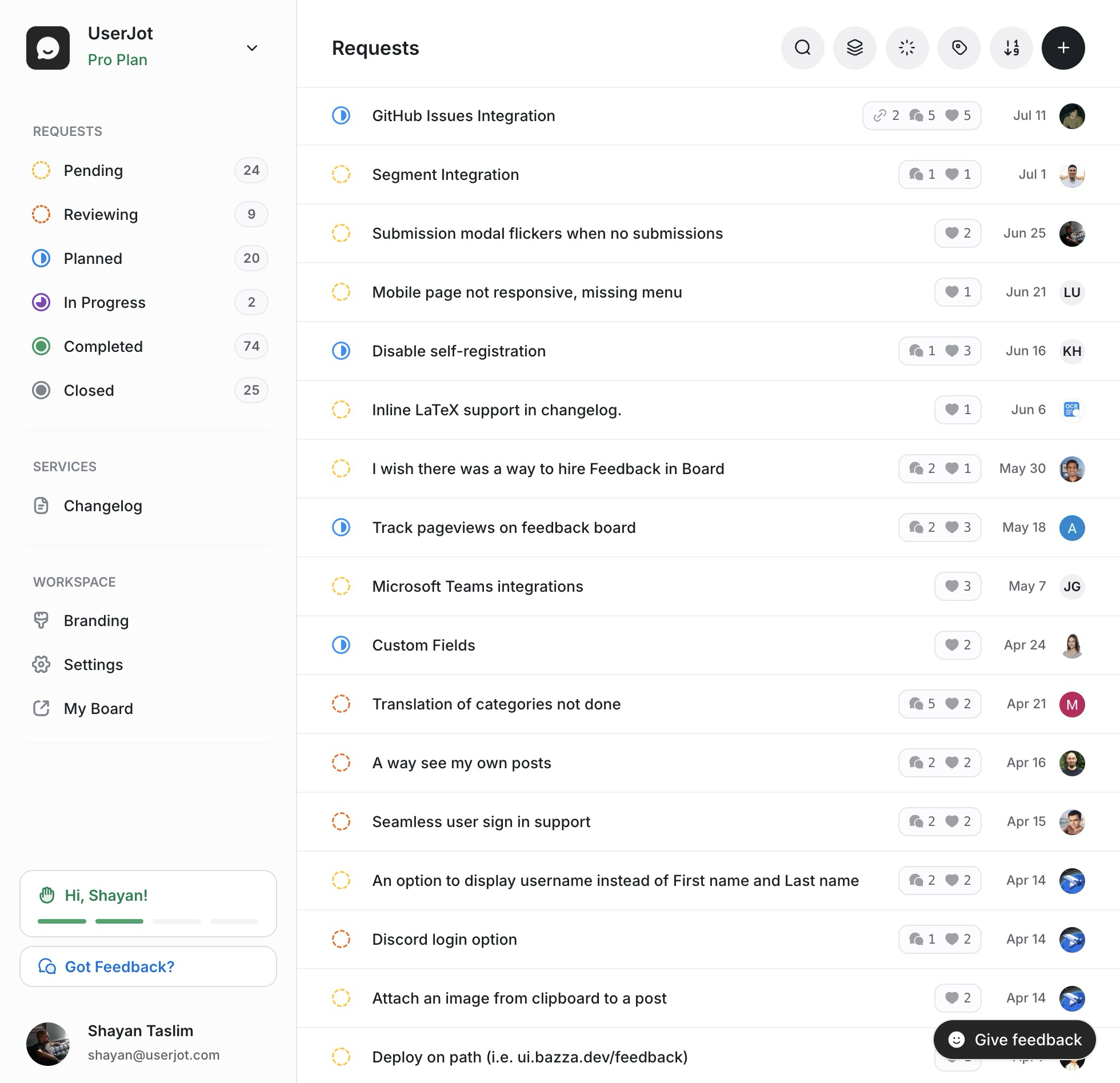
Get everything in one place. Feedback scattered across email, Slack, and support tickets can't be evaluated fairly. You need a single source of truth — dedicated feature request software that centralizes everything. This is one reason we built UserJot the way we did.
Understand before scoring. For each meaningful request, write down the underlying problem, who's affected, and how urgent it actually is. Skip this step and your scores will be garbage.
Group similar requests. "Add CSV export," "Excel download," and "data export" are the same thing. Treat them as one item with multiple votes, not three separate requests.
Pick a framework and stick with it. RICE if you have data. ICE if you need speed. MoSCoW for alignment conversations. The value/effort matrix for whiteboard sessions. Weighted scoring if you need custom criteria. The framework matters less than using it consistently.
Validate the winners. High scores don't guarantee success. Before building your top-ranked items, make sure they actually matter. Talk to users. Check that your assumptions hold.
Close the loop. Even when you say no, let people know. "Not now, here's why" builds more trust than silence. Users who feel heard keep giving you feedback even when you don't build their specific request.
Common Mistakes
A few patterns show up repeatedly when teams try to assess feature requests.
Treating every request the same. One enterprise customer's request isn't equivalent to one free user's suggestion. Weight your inputs based on who's asking and what they represent.
Following the loudest voice. The person who complains most might represent a tiny segment. Look for patterns in your data, not just volume in your inbox.
Skipping validation. A high RICE score doesn't mean you should build something. The score is based on your estimates, and your estimates might be wrong. Test before you commit.
Ignoring effort completely. A feature that scores high on value but takes six months might not beat three smaller features that each ship in two weeks. Factor in what else you could accomplish with the same resources.
Forgetting your strategy. Not every good idea belongs in your product. If you're building a focused tool for small teams, an enterprise feature request might score well but still be wrong for you. Stay true to what you're building.
The Short Version
Pick a framework, apply it consistently, understand the real problem before you evaluate solutions, and talk to your users before you build.
The specific framework matters less than having one. Gut instinct is fine for lunch. For deciding what to build next, you need something more systematic.
FAQ
What is an effective way to assess user requests for additional features and functions?
Use a framework like RICE (Reach, Impact, Confidence, Effort) or the simpler ICE scoring to compare requests objectively. Understand the underlying problem first, not just the requested solution. Group similar requests to find patterns. Apply the same criteria to everything so you can compare fairly. And validate your top-ranked items before building them.
How do you prioritize feature requests as a product manager?
Start by grouping similar requests together. Apply a scoring framework to rank them against each other. Consider strategic fit, user demand, potential impact, and implementation effort. Always validate high-scoring items with real users before committing to build them. And close the loop with the people who made requests, even when you're not building what they asked for.
What frameworks do product managers use for feature prioritization?
The most common ones are RICE (data-driven scoring), ICE (quick decisions when you lack data), MoSCoW (categorization for stakeholder alignment), the Value vs Effort Matrix (visual prioritization), the Kano Model (understanding satisfaction drivers), and weighted scoring (custom criteria for specific situations). Pick based on what your situation requires.
How do you evaluate the value of a user feature request?
Consider how many users want it, how much it would improve their experience, how it fits with your product strategy, the potential revenue impact, and whether competitors already have it. Weight these factors based on what matters most to your specific business and situation.
How do you say no to feature requests?
Be direct and specific about your reasoning. Something like "We're focused on [X] right now, so this isn't on our roadmap. We're tracking interest though, and if enough people need it, we'll revisit." Thank them for sharing the feedback. You want people to keep giving you input even when you can't build everything they ask for.
What's the difference between RICE and ICE scoring?
RICE includes a Reach component (how many users are affected) while ICE doesn't. RICE is more precise but requires user data to be meaningful. ICE is faster and works well when you're still guessing about your numbers. Both frameworks produce similar results for most prioritization decisions.
How do product managers keep track of feature requests?
The most effective approach is a centralized system where requests are collected, categorized, and connected to the users who made them. Tools like UserJot provide public voting to surface demand, automatic duplicate detection to group similar requests, and status tracking so users can see where their request stands. Scattered spreadsheets and email threads become impossible to analyze once you have any meaningful volume.